Wednesday, August 19, 2015

The Heart of the Tin Man

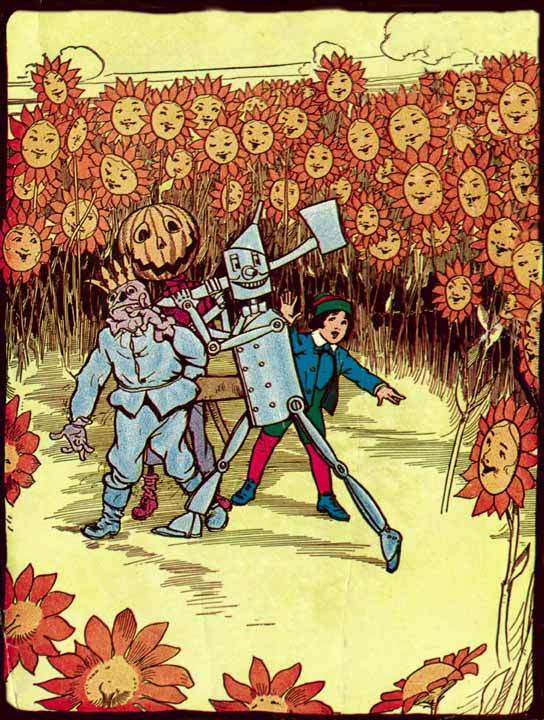
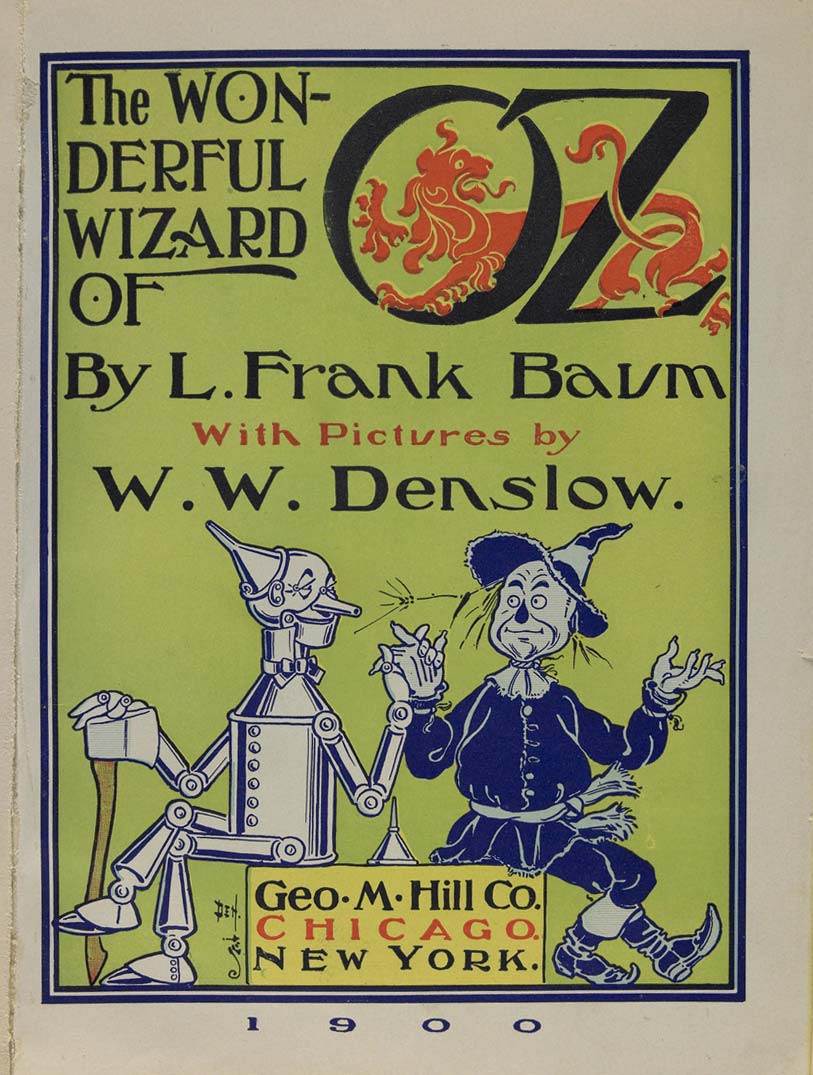
The Tin Woodman as Illustrated by W.W. Denslow, 1900 
"When a man's an empty kettle, he should be on his mettle. And yet I'm torn apart. Just because I'm presumin' that I could be kind of human, if I only had a heart." ---Words by E.Y. "Yip" Harburg

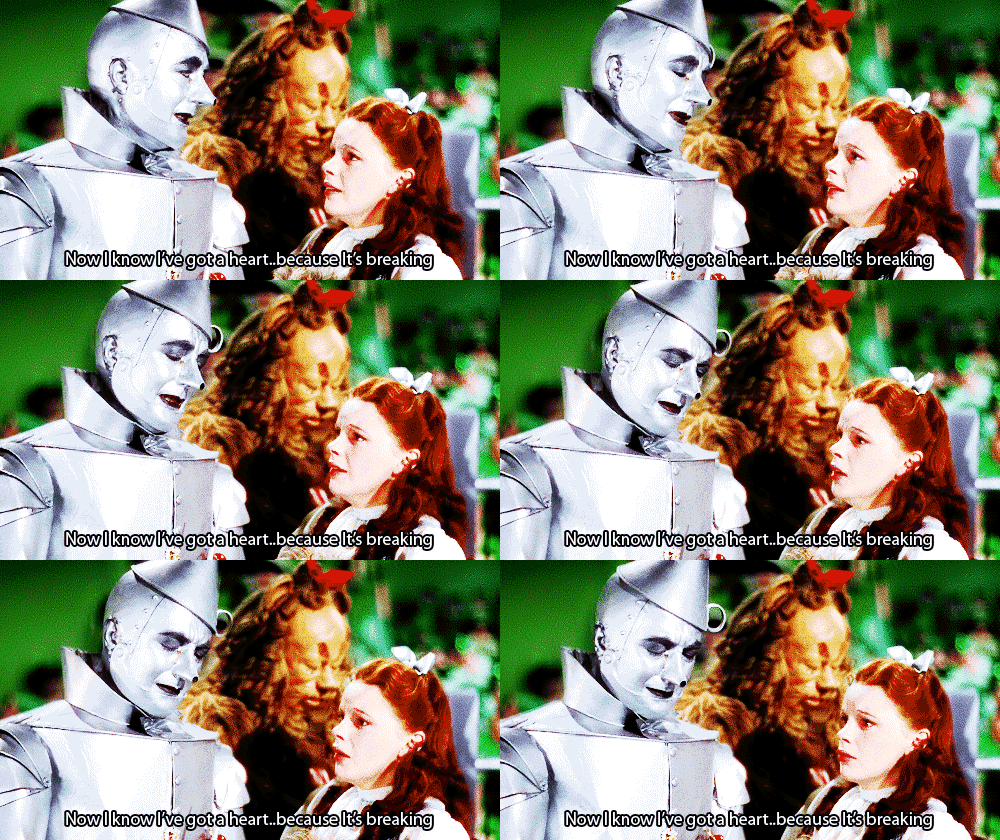
The Wizard of Oz, MGM Pictures, 1939
The most beloved figure in the history of folklore is perhaps the one who desired a heart the most. The Tin Man first appeared in literature in 1900 with the publication of The Wonderful Wizard of Oz as a companion to the immortal Dorothy Gale. He is the expression/exploration of one of three simple dynamics, where the Scarecrow lacks a brain and the Cowardly Lion lacks the Nerve (Courage), he lacks a physical heart. The invention of three companions who each desire something we inherently possess as human beings establishes many existential thoughts. What would it mean if we were missing a brain or a heart? How would we function? Could one work with out the other? As the Oz tales continue in later works by L. Frank Baum the Tin Man and the Scarecrow become inseparable best friends and there is metaphorical irony in the success of their further adventures, for surely when the brain and the heart are united nothing is impossible.
Fred Stone as the Scarecrow & David Montgomery as the Tin Man, 1902
The Tin Man is notably one of the first bionic/mechanical men to appear in literature. Surely L. Frank Baum was inspired by the Industrial Revolution and the romanticism of a changing world. Long before he started writing The Wonderful Wizard of Oz Baum worked as an editor for a magazine specialized in store window displays. It is said that Baum was once asked to set up a hardware store window "He wanted to create something eye-catching...so he made a torso out of a washboiler, bolted stovepipe arms and legs to it and used the underside of a saucepan for a face. He topped it with a funnel hat and what would become the inspiration for Tin Woodman was born." --- As told by Harry Neal Baum about his father to the Indianapolis Times, May 3rd, 1965.
Oliver Hardy as the Tin Man, The Wizard of Oz, 1925
The Tin Man develops as a noble figure in the later Oz tales. He becomes Emperor to the Winkies who were once conquered by the Wicked Witch of the West (The Gilikins are the people of the North, the Munchkins are the people of the East and the Quadlings are the people of the South) and resides within the castle where the witch was destroyed.
The Marvelous Land of Oz, John R. Neill, 1904
In the 1904 book titled The Marvelous Land of Oz the Tin Man is given the name Nick Chopper. 'The name came from the 1902 musical extravaganza, in which Nick (from "Niccolo") Chopper sang an interpolated song "Niccolo's Piccolo." David C. Montgomery portrayed him in that production, and Oliver Hardy in the same role was the highlight of the 1925 Chadwick silent picture of The Wizard of Oz.' --- Michael Patrick Hearn, The Annotated Wizard of Oz, 1973

Poster for the 1902 Extravaganza at the Chicago Opera House
In the Wonderful Wizard of Oz the Tin Man tells his story: "I was born the son of a woodman who chopped down trees in the forest and sold them for a living. When I grew up I too became a wood-chopper, and after my father died I took care of my old mother as long as she lived. Then I made up my mind that instead of living alone I would marry, so that I might not become lonely."

"There was one of the Munchkin girls who was so beautiful that I soon grew to love her with all my heart. She, on her part, promised to marry me as soon as I could earn enough money to build a better house for her; So i set to work harder than ever. But the girl lived with an old woman who did not want her to marry anyone, for she was so lazy she wished the girl to remain with her and the the cooking and the housework. So the old woman went to the wicked Witch of the East, and promised her two sheep and a cow if she would prevent the marriage. Thereupon the wicked Witch enchanted my axe, and when I was chopping away at my best one day, for I was anxious to get the new house and my wife soon as possible, the axe slipped all at one and cut off my leg."

"This seemed a great misfortune, for I knew a one-legged man could not do very well as wood-chopper. So I went to a tin-smith and had him make me a new leg out of tin. The leg worked very well, once I was used to it; but my action angered the wicked Witch of the East, for she had promised the old woman I should not marry the pretty Munchkin girl. When I began chopping again my axe slipped and I cut off my right leg. Again I went to the tinner, and again he made me a leg out of tin. After this the enchanted axe cut off my arms, one after the other; but, nothing daunted, I had them replaced with tin ones. The wicked witch then made the axe slip and cut off my head, and at first I thought that was the end of me. But the winner happened to come along, and he made me a new head out of tin."
Tin Man by Barry Moser , 1985

"I thought I had beaten the wicked Witch then, and I worked harder than ever; but I little knew how cruel my enemy would be. She thought of a new way to kill my love for the beautiful Munchkin maiden, and made my axe slip again, so that it cut right through my body, splitting me into two halves. Once more the winner came to my help and made me a body of tin, fastening my tin arms and legs and head to it, by means of joints, so that I could move around as well as ever. But, alas! I had no heart, so that I lost all my love for the Munchkin girl, and did not care whether I married her or not. I suppose she is still living with the old woman, waiting for me to come after her."

"My body shone so brightly in the sun that I felt very proud of it and it did not matter now if my axe slipped, for it could not cut me. There was only one danger---that my joints would rust; but I kept an oil-can in my cottage and took care to oil myself whenever I needed it. However, there came a day when I forgot to do this, and, being caught in a rainstorm, before I thought of the danger my joints had rusted, and I was left to stand in the woods until you came to help me. It was a terrible thing to undergo, but during the year I stood there I had time to think that the greatest loss I had known was the loss of my heart. While I was in love I was the happiest man on earth; but no one can love who has not a heart, and so I am resolved to ask Oz to give me one. If he does, I will go to the Munchkin maiden and marry her."---The Wonderful Wizard of Oz, 1900
The Wonderful Wizard of Oz, W. W. Denslow, 1900
The Tin Man's plight is clear, for how can he exist completely without a heart? His tale makes us wonder what life would be like without one of our core strengths. Baum's inspiration for the Tin Man might have stemmed from witnessing, as a youth, the invention of prosthetic limbs for amputees of the Civil War. His own Uncle was tortured by his experiences in the war. The modern advancement in medicine and technology established a multitude of questions regarding humanity. Baum himself suffered a heart condition for his entire lifetime, the Tin Man is perhaps an extreme metaphor for his existential thoughts.

The Marvelous Land of Oz, John R. Neill, 1904

"Reality and unreality are so intertwined that it is often difficult to know where one leaves off and the other begins."---L. Frank Baum, "Why the Wizard of Oz Keeps on Selling.", The Annotated Wizard of Oz, 2000

The Tin Woodman of Oz, John R. Neill, 1918
Baum's novels often carry an even balance of light hearted wonder and macabre experiences. In a later Oz tale titled: The Tin Woodman of Oz (1918) Nick Chopper meets a Tin Soldier named Captain Fyter who suffered a similar fate when he too became made of tin and fell in love with the same Munchkin girl. Together they journey to find the tinsmith who might still posses their original body pieces (,as you can not be killed in Oz). Nick Chopper discovers that what was saved of his body parts has now been combined with that of Captain Fyter's to make a whole new man altogether. Like Frankenstein's monster the man is pieced together with the spare flesh and blood body parts. Chopfyte as he is called is Baum's exploration of technological overdevelopment. Thereafter the Tin Men discover the beautiful Munchkin maiden, Nimmee Aimee, who has ironically fallen in love with Chopfyte, the man of spare body parts. The most interesting part of the tale is when the Tin Man looks upon his former head and thinks upon which is better.
John R. Neill, 1918
The most beloved depiction of the Tin man is certainly the portrayal in the 1939 film by Jack Haley. Jack brought a sentimental quality to the Tin Man that is unprecedented. You believe in his desire for a heart. The tone of voice that Haley developed for the Tin Man was taken directly from reading bedtime stories to his son.
Cover by John R. Neill, 1918

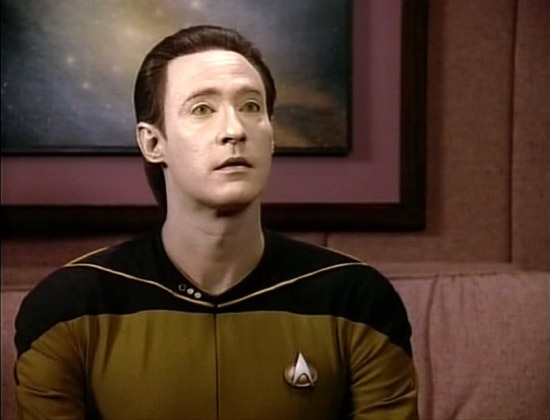
The Tin Man might have been the inspiration for the character Lieutenant Commander Data in Star Trek the Next Generation (1987-1994). Data is a fully functional android who is self aware, he experiences ongoing difficulties with not being able to fully comprehend human emotion. An  episode in 1991 was even titled: Tin Man

Brent Spiner as Data in Star Trek: The Next Generation, Paramount Television
The Tin Man appears in the revisionist tale Wicked (1995). 'In the book, Nessarose - the Wicked Witch of the East - is seen enchanting the axe to swing around and chop off Nick Chopper's limbs. She does this for a peasant woman who wishes to stop her servant, probably Nimmie Amee, from marrying Nick Chopper. This seems to be close to the Tin Man's origin in the original books, but from the Witch's perspective.' ---Wikipedia
Wicked Witch of the East, John R. Neill, 1918
In 2005 the Muppet's made their interpretation of the classic tale with Gonzo as the Tin Man. 
The Muppets' Wizard of Oz, Walt Disney Pictures, 2005
A notable revisionist cinematic experience was developed by the Sci Fi Channel in 2007 titled: Tin Man. This mini-series was a futuristic take on the land of Oz with a steampunk twist giving the 'Tin Man' (played by Neal McDonough) a more heroic position. The movie starred Zooey Deschanel, Richard Dreyfuss, and Alan Cumming.


"I've heard that anyone can be conquered with kindness, no matter how ugly they may be." ---Tin Woodman, The Marvelous Land of Oz, 1904 
Jack Haley, MGM Pictures, 1939
The most significant words spoken about the Tin Man are by Frank Morgan who played the Wizard in the 1939 film, when he says: "You want a heart! You don't know how lucky you are not to have one. Hearts will never be made practical until they can be made unbreakable. And remember my sentimental friend, that a heart is not judged by how much you love, but by how much you are loved by others." 

Source Material:

  • The Annotated Wizard of Oz, L. Frank Baum, Michael Patrick Hearn, 2000, W.W. Norton & Co Inc, New York, NY
  • All Things Oz, Edited by Linda Sunshine, 2003, Clarkson Potter/ Publishers, New York, NY
  • The Wizard of Oz: 75 Years Along the Yellow Brick Road, Life Books, 2013
  • The Wizard of Oz: 75th Anniversary, I-5 Publishing, Irvine, CA, 2014
  • The Wizard of Oz (Film), Metro-Goldwyn-Mayer Pictures, 1939
  • The Marvelous Land of Oz, L. Frank Baum, Dover Publications Inc. 1969, New York, NY
  • The Tin Woodman of Oz, L Frank Baum, Dover Publications Inc. 2000, New York, NY
  • Wikipedia.com
   

Wednesday, July 22, 2015

Chicago and Oz

Chicago World's Fair (1893) by Thomas Moran

The World's Columbian Exposition or the Worlds Fair of 1893 brought unimaginable marvels to the city of Chicago, highlighting electric innovation and international culture, art,  and architecture. This World's Fair marked the 400th celebration of Christopher Columbus' discovery of the New World. The fair spread over South Shore stretching through Hyde Park, Jackson Park Woodlands and Woodlawn. The Fair was established in a very short amount of time by means of sophisticated construction utilizing white stucco. The white buildings illuminated against the darker architecture that is Chicago. It was this very experience that influenced the development of one of America's greatest treasures, The Wonderful Wizard of Oz.


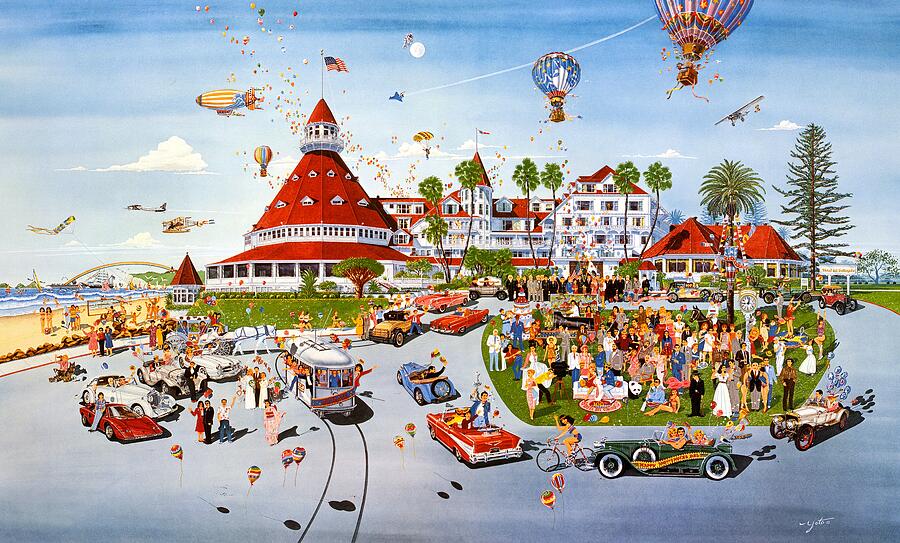
Nostalgia Hotel Del Coranado by John Yato 2011

Over the last century many States have taken claim over the land of Oz. Kansas for obvious reasons boasts many museums and the official American Yellow Brick Road. Chittenango, New York, birthplace to famed author L. Frank Baum is home to many Oz related festivals. California has the historical Hotel Del Coronado in San Diego where Baum penned many of his later Oz tales. Seattle is called the Emerald City because it is lush with greenery. Nebraska has Omaha the word famously painted on the Wizard's Balloon in the 1939 film. Many cities continue to boast that Oz has a particular localized relevance but Chicago holds the flag, for it was the experience of Chicago that helped shape the novel.


L. Frank Baum, Los Angeles Times (1911)

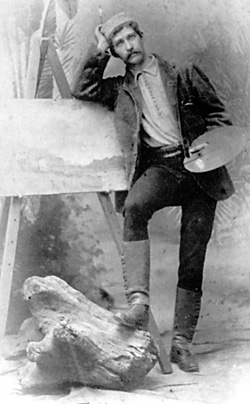
L. Frank Baum lived at 1667 North Humboldt Boulevard Chicago, Illinois, where now a simple plaque pays homage to the famed author. There he channeled his experiences of a changing world into a humble story for children an adults alike. Baum was born to a wealthy family in Chittenango, New York on May 15th, 1856. His development and experiences would be shaped by a life of travel. Early in his life he grew up on an estate outside of Syracuse called Rose Lawn, there he and his brothers and sisters were tutored and there he developed his imagination. 


The Scarecrow as played by Fred A. Stone (1902)

Baum suffered from night terrors as his powerful imagination was vivid and often haunting. Baum eventually revealed that it was on his childhood estate that he had a reoccurring nightmare in which he was being chased by a certain Scarecrow. 


Baum was nurtured very closely because he had been born with a heart condition and at times had to refrain from too much physical activity. Baum's health would be the very thing that created necessity for departures from one town to the next. Perhaps the Tin-Man and his longing for a heart was Baum's desire for a stronger one himself. The notions however did not weigh him down, he was living during a time of remarkable innovation. In his lifetime he witnessed the development of electricity, the industrial revolution, and powerful political leaders. He also had a first hand experience with the Women's Suffrage Movement as he married one of the founding member's (Matilda Gage's) daughter, Maud Gage.


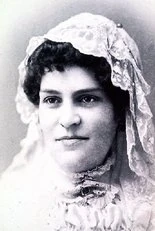
Maud Gage Baum

L. Frank Baum developed an early appreciation for the written word as a youth. After petitioning his parents for a printing press (, which were greatly advertised in children's magazines,) Baum created his first amateur journalism with The Rose Lawn Home Journal, a monthly paper that explored literature, poetry and the art of stamp collecting. Baum's interest in stamps would lead to the development of his first book, Baum's Complete Stamp Dealers Directory. Baum's interests would bounce from one unique experience to another. He would later produce a monthly poultry column, The Poultry Record after he and his family developed the interest of breeding chickens. Baum found his first commercial success with the publication of The Book of Hamburgs, which hi-lighted his experiences and understandings with poultry farming.


L. Frank Baum as Hugh Holcomb
in THE MAID OF ARRAN (1882)

Baum's growing interests eventually shifted into the theater where he could write and produce. Baum moved to Richburg, New York to pursue his interests as a Thespian. By 1882 he had written three complete productions. His first theatrical success came from an adaptation of a Scottish novel titled A Princess of Thule (1877) written by William Black. His play, The Maid of Arran found such success in his hometown that he eventually took it on the road traveling throughout New York and across the continent. This would be Baum's experience seeing the Kansas plains. Baum wrote several other plays that were never produced. His theatrical success would only be matched once again with his musical extravaganza adaptation of The Wonderful Wizard of Oz.


Aberdeen, Photo by L. Frank Baum (1888)

Baum, after marrying Maud Gage moved the the Dakota Territory to a town called Aberdeen. Less driven by his theatrical career he wanted to make a home for his wife and his first child. South Dakota was the place for business opportunities. Baum's first opportunity in Aberdeen was with amateur photography for a publication called The Aberdeen Daily News. He used his early success to finance Aberdeen's first novelty store called Baum's Bazaar. Frank, as he liked to be called, and Maud were very social, they both attended card parties, dances and regularly sat down with mediums. They shared unconventional spiritual views and were unafraid to explore them. Eventually they would enter the Theosophical Society which was developed around the famous and mysterious Helena Blavatsky. Baum thereafter took over a weekly publication called the Dakota Pioneer, renaming it, the Saturday Pioneer, this paper among other things examined the changing world where Baum could write about anything from electrical inventions to women's suffrage. It was here that Baum may have been inspired to write about the Good Witch Glinda and her powerful Book of Records (A Book that details global events as they are happening).
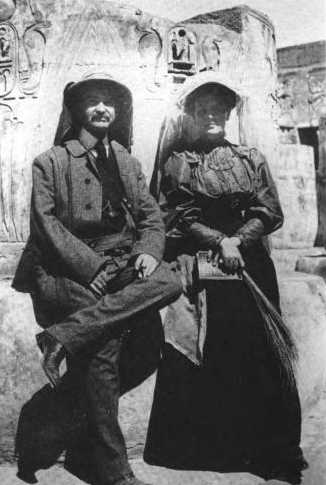

Maud and Frank in Egypt 1906

By 1891 many people were deserting the Dakota Territory, and Baum's Bazaar went under. L. Frank Baum's heath conditions pushed the family into a new direction. Baum quickly accepted a job with the Evening Post of Chicago. He was mindful to take his family in that direction because the World's Columbian Exposition was set to open in 1893. There business was sure to be booming. Baum disliked the Evening Post so much that after only a month he left and found work as a traveling China Salesman. This delicate work surely inspired the Dainty China Country in The Wonderful Wizard of Oz.
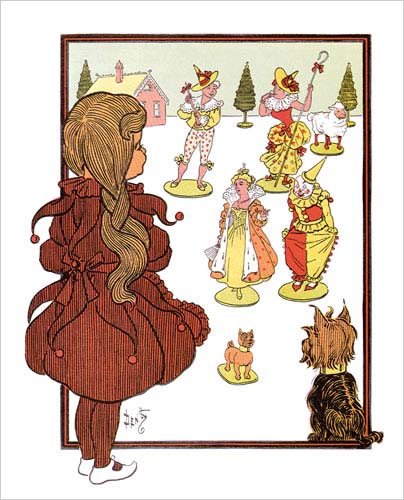
The Dainty China Country, W. W. Denslow (1900)

It was somewhere between May and October of 1893 that L. Frank Baum made his way to the Chicago World's Fair which was the splendor that influenced the famed Emerald City. The White City as it was called, glistened with electrical wonder powered by General Electric who at the time was backed by Thomas Edison and J. P. Morgan. Here Baum was inspired by the theatrics put into spectacle, from a distance the fair looked as if built by marble. The elaborate statues were unprecedented, but it was all fake, it was all stucco painted like marble.

Architectural Building World's Columbian Exposition (1893)

"The impressive, dazzling palaces that glinted on the edge of Lake Michigan were, in truth, hurriedly erected temporary sheds painted to look like marble; the Fair was a film set before cinema had been invented. The numerous impressive sculptures that adorned the palaces weren't hewn from marble, but were rather made from staff, a lightweight mix of plaster, cement and fibers (a kind of Plaster-of-Paris). So the grand palaces were actually storage sheds covered in a veneer of plaster that was most usefully employed to reset broken bones.The White City's combination of beauty and phoniness influenced Baum in his creation of the Emerald City."--- Rebecca Loncraine, The Real Wizard of Oz


The White City (1893)

L. Frank Baum's further influence with whimsy might have been driven by witnessing the invention of many things and experiencing them at the Fair, there were Cracker Jacks, phosphorescent lamps, bubble gum, moving walkways and the very first Ferris Wheel built by George Ferris, measuring 264ft high.

L. Frank Baum (1904)
Although Baum had been successful as a bohemian, what with journalism, theatre, photography, etc. He had never quite thought to write for children. In his later career he expressed that as a youth he certainly wanted to be remembered as a literary author. It was Matilda Gage, his Mother-in-Law who influenced him to do so. Baum had a reputation for telling fables to the neighborhood and children would swarm his house begging for stories about fairies and witches. Matilda told Baum that he was a damn fool if he didn't write his stories down, and it was this very notion that changed L. Frank Baum's life.


The Wizard of Oz is a fictional tale, but it certainly highlights all of L. Frank Baum's various experiences: traveling by train though the Kansas Prairie, his delicate heart condition, his dreams of a certain Scarecrow, the wizards of deception behind the World's Fair, etc. The Wonderful Wizard of Oz was published in 1900. The success carried Baum into the literary world of immortality. He immediately developed the book into a musical comedy extravaganza which debuted in Chicago's Grand Opera House in 1902 and later became a smash hit on Broadway in 1903.
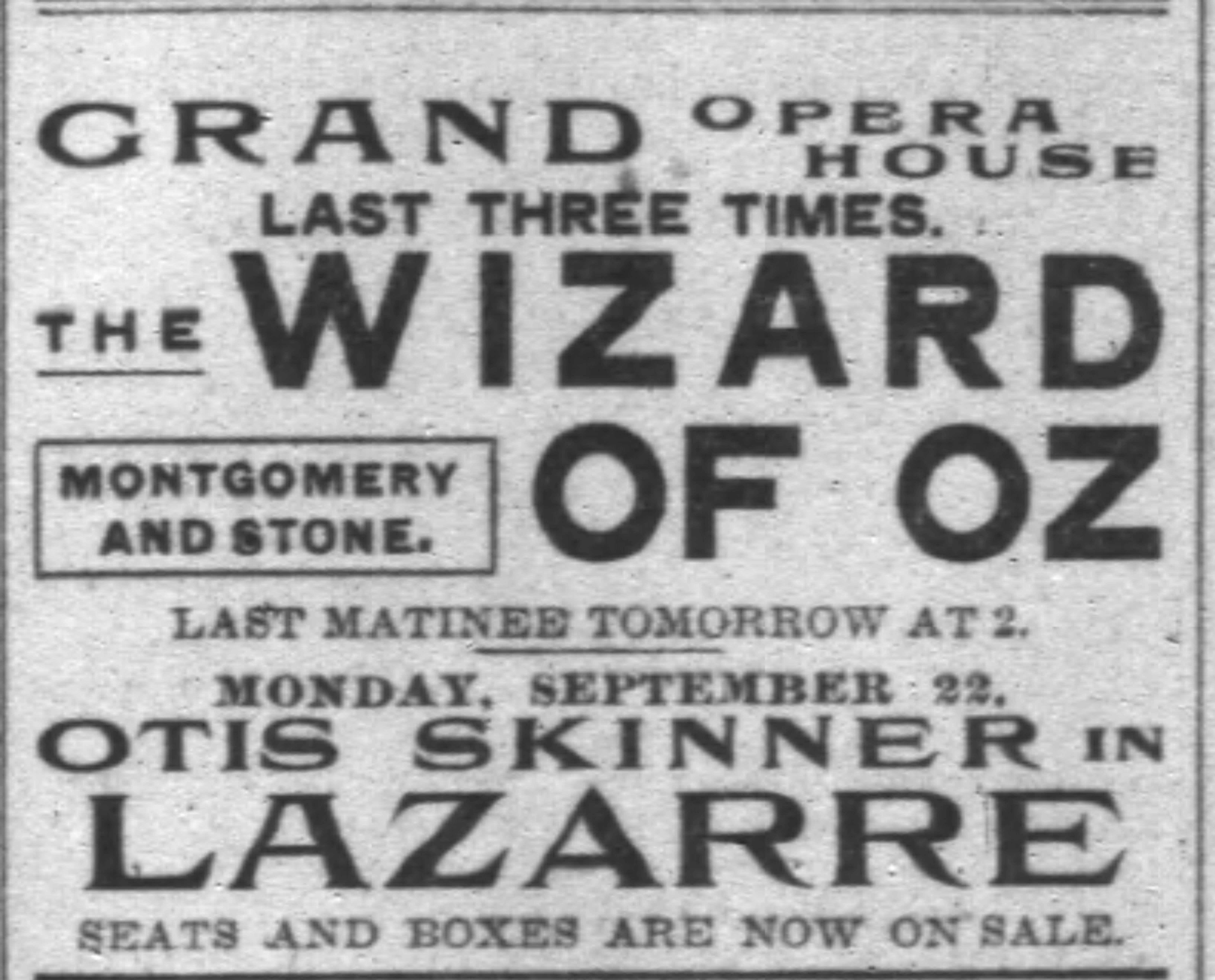


The success of his show led to the development of further Oz productions. Eventually, in his late life Baum journeyed into Hollywood where he made several attempts to translate his stories to screen. Before the famed movie of 1939 the Wizard of Oz had seen several silent film adaptations. Baum was left nearly bankrupt in his attempt to get his story to it's greatest translation. Perhaps he knew how powerful it could be. L. Frank Baum died at the age of 63 in 1919, just 20 years before the famous MGM classic film was developed. Now there is not one person who is unfamiliar with the Lion, the Scarecrow and the Tin Man.

Shirley Temple as Tip in The Marvelous Land of Oz 1960
Tales about Oz have been reinvented time and time again. Shirley Temple developed a later Oz novel The Marvelous Land of Oz into a small production for her televised show in 1960. In 1985 Disney developed a dark and underrated look into Baum's work with Return to Oz, a live action film that was in ways closer to the source material than the first film.

Dorothy (Fairuza Balk),Disney's Return to Oz (1985)

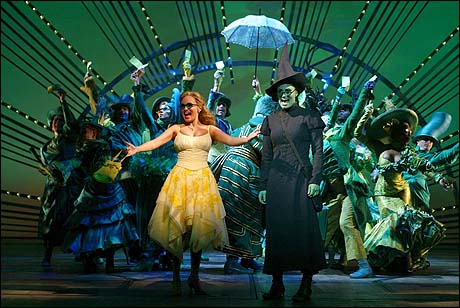
The most significant Oz-volution is notably Wicked: The Life and Times of the Wicked Witch of the West, written by Gregory Maguire. This famed novel explores ideas of scapegoating that are so often cast against WITCHES. Much like the original, this novel has seen a proper Broadway adaptation that opened in 2003, the production has since made Wicked a household concept. Wicked has toured every major city in the world, including the Windy City. Wicked is considered one of the highest grossing musicals of all time.

Playbill (2003) Kristen Chenoweth & Idina Menzel

L. Frank Baum is most notably honored by Oz Park in Chicago, Illinois. The park was developed to pay homage to Baum's Oz, an expansive area rich with a grand flower garden and 4 marvelous sculptures displaying Dorothy and her dearest companions. The Park was dedicated in 1976, bordering Webster and Larrabee Streets on Chicago's North side.

Oz Park, Chicago Illinois Photo by: Ron Szematowitcz 
     
For more information on Chicago visit: Chicago Day Tripping


Source Material:

  • The Man who was L. Frank Baum --- http://articles.chicagotribune.com 
  • Chicago Tribute Markers of Distinction --- http://www.chicagotribute.org
  • The Wizard in the White City ---  http://backstoryradio.org
  • Wikipedia.com
  • Life Magazine: The Wizard of Oz: 75 Years Along the Yellow Brick Road, Time Home Entertainment Inc. 2013
  • The Wizard of Oz: Celebrating 75 Years of Movie Magic, I-5 Publishing 2014
  • The Annotated Wizard of Oz: L. Frank Baum, W. W. Norton & Co. Inc. Michael Patrick Hearn 1973

Monday, May 18, 2015

The Cry of the Banshee

Banshee by Jana Heidersdorf, Germany 1993
One of the most mysterious figures in the annals of folklore is the Banshee, stemming out of Scottish and Irish lore, a dark feminine figure who comes with a warning, a promise that mortal death is near. As Death collects souls, she is the figure who announces his travel. She is most notably depicted with long streaming hair and a dark cloak. She is known for her incessant weeping as she releases continual tears from her fiery red eyes.
Jana Heidersdorf, Germany
[The Banshee (from ban [bean], a woman, and shee [sidhe], a fairy) is an attendant fairy that follows the old families, and none but them, and wails before a death. Many have seen her as she goes wailing and clapping her hands. The keen [caoine], the funeral cry of peasantry, is said to be an imitation of her cry. When more than one banshee is present, and they will wail and sing in chorus, it is for the death of some holy or great one. An omen that sometimes accompanies the banshee is the coach-a-bower [cóiste-bodhar]---an immense black coach, mounted by a coffin, and drawn by headless horses driven by a Dullahan. It will go rumbling to your door, and if you open it, according to Croker, a basin of blood will be thrown in your face. --- W. B. Yeats, Irish Fairy & Folk Tales
http://fantasycreatureencyclopedia.blogspot.com
'The mourning of the deceased is not just the affair of surviving relatives in Ireland. In years past, the measure of a person's respect and stature in the community could be seen in the number of mourners at a funeral and the breadth of their grieving. Professional women keeners, often old women, were paid in drink to weep at the graveside of eminent figures in the community. The Church frowned upon the entanglement of these often alcoholic women and their funerary services, perhaps giving rise to another theory that banshees are the ghosts of professional keeners doomed to unrest as a result of their insincere grieving. Interestingly, this does touch on a basic component of the banshee legend: that banshees follow certain families. If banshees are the ghosts of deceased keeners, their accompaniment is probably due more to a sense of loyalty than a sense of guilt.'--- C. Austin, The Banshee, Celtic Death Messenger


A Hateful Banshee on a Windy Night by H.R. Heaton
According to Irish legend the banshee can only cry for a few major families, the O'Briens, the O'Neills,  O'Connors, O'Gradys, O'Donnells and Kavanaghs. Intermarriage has since extended this list. Documented superstitions follow families even into Colonial America. Sightings have been reported allegedly even as of 1948. The most prevalent American tales see the banshee traveling to to the likes of Tar River in Edgecombe County, North Carolina. Legend has it that she can still be seen and heard on a hill in the badlands of South Dakota near Watch Dog Butte.  

Banshee, Brian Froud
The BEAN-NIGHE as she is referred to in Sottish Highlands is comparable to LITTLE-WASHER-BY-THE-FORD (essentially a euphemistic name for the banshee), a figure who is seen at the edge of a river washing the bloodstained clothes of those who are going to die, typically they remain near the water. It is said that if you dare to ask the bean-nighe for who she cries, she will tell you.

Bean-nighe, Brian Froud 1978
'It is said that these spirits are the ghosts of women who died in childbirth and that they are fated to perform their task until the day when they would have normally died.' ---Brian Froud & Alan Lee, Faeries


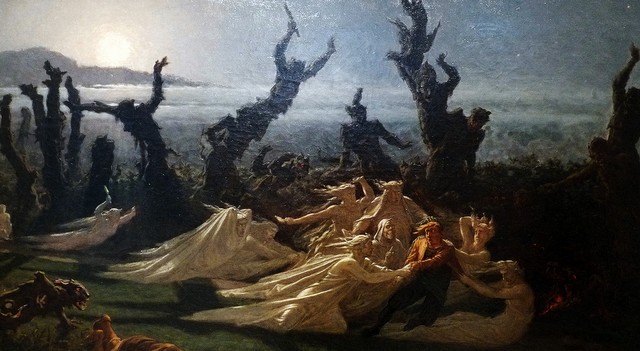
Les Lavandières de la nuit, Yan Dargent, 1861
"Women dying in childbed were looked at as dying prematurely, and it was believed that, unless all the clothes left by them were washed, they should have to wash them themselves till the natural period of their death." ---J.G. Campbell, Superstitions of the Scottish Highlands


Death, Brian Froud
Where she stands or sits is really no different and is most likely comparable to a faerie-ring, for once you are in her dwelling you fall under her spell. She can appear in the form of a young maiden adorned in white, wearing a shroud, but more frequently as a wretched old hag with long finger nails and a black veil. And as she disguises herself in various female forms, there is no deception, for once you look into her eyes you will see that she never stops shedding tears. Popular urban tales attribute her as a death deity, perhaps the incessant cries are for the too soon departed. Although it is easy to wrap this figure up as a ghost or a demon, she is none of the sort. Bean-si refers to a female dweller of a fairy mound. Her Scottish counterpart bean-shídh in deeper esoteric culture is also known as aos si, spirits or ancestors of nature and the survivals of pre Christian Gaelic Dieties.
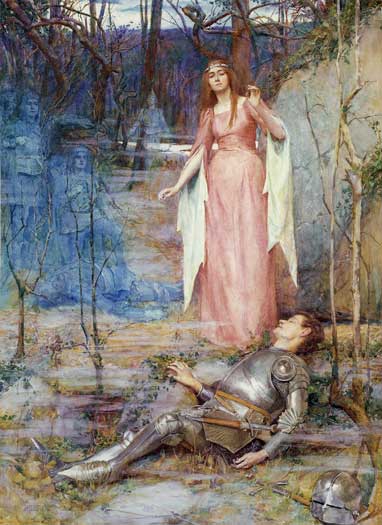
 La Belle Dame sans Merci, Henry Meynell Rheam 1897

Source Materials:

  • Irish Fairy & Folk Tales, W. B. Yeats, Dorset Press 1986, New York
  • Tales of the Banshee, Patrick F. Byrne, Litho Press 1987, Midleton Co. Cork
  • An Encyclopedia of Fairies, Katherine Briggs, Pantheon Books 1976, NY
  • Good Faeries & Bad Faeries, Brian Froud, Simon & Schuster 1998, New York, NY
  • Faeries, Brian Froud and Alan Lee, Abrams 1978, NY
  • www.irelandseye.com
  • merganser.math.gvsu.edu
  • www.yourirish.com
  • fantasycreatureencyclopedia.blogspot.com
  • wikipedia.com
  • pinterest.com


Thursday, March 5, 2015

Spinning Wheels, Spindles & Sleeping Death

Faerie stories are incomplete without complication, beyond evil villains and their action there is a core element that drives a true fairytale narrative and that is the mystery of the unknown. Heroes travel through complicated circumstances, in Little Red Riding Hood's case it is escaping a dark prison after she is pulled from the Wolf's stomach, but she longed to take the unknown path. Cinderella must remember that there is a time limit to her enchantment, what will her future be after the stroke of midnight? Hansel and Gretel must brave the cannibalistic witch, by coaxing her into the oven. Snow White and the Sleeping Beauty are tied together by the a curse called: Sleeping Death.

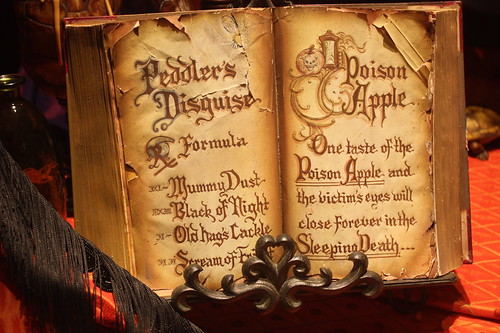
Book as seen on Main Street USA, Disneyland CA
The Sleeping Death Curse seems by far one of the most peculiar circumstances in faery realms. In the Snow White and the Seven Dwarf's it is not reavealed how these powers came to be, only that the wicked Queen had a jealous heart and crafted a poisoned apple .

'When she heard the looking-glass speak thus she trembled and shook with anger. "Snow-white shall die," cried she, "though it should cost me my own life!" And then she went to a secret lonely chamber, where no one was likely to come, and there she made a poisonous apple. It was beautiful to look upon, being white with red cheeks, so that any one who should see it must long for it, but whoever ate even a little bit of it must die.' ---The Brothers Grimm

Walt Disney's 'Snow White and the Seven Dwarves', 1937
The wicked Queen then disguises herself as an old peasant woman, having already appeared to the child in two different costumes(, perhaps this is where the idiom 'Third time's a charm' derives from.) She then makes her way back to Snow White to offer her an apple.

'Snow White', Charles Santore
"All right," answered the woman; "I can easily get rid of my apples elsewhere. There, I will give you one." "No," answered Snow-white, "I dare not take anything." "Are you afraid of poison?" said the woman, "look here, I will cut the apple in two pieces; you shall have the red side, I will have the white one." For the apple was so cunningly made, that all the poison was in the rosy half of it. Snow-white longed for the beautiful apple, and as she saw the peasant woman eating a piece of it she could no longer refrain, but stretched out her hand and took the poisoned half. But no sooner had she taken a morsel of it into her mouth than she fell to the earth as dead.' ---The Brothers Grimm

There are many peculiar notions here, one predominantly being the allusion to the biblical parable of Adam and Eve. Here the apple is split into two parts and the wicked Queen takes the first bite, and then Snow White falls after taking her bite. Fading into her Sleeping Death Snow White is allegorically experiencing the same plight of Adam and Eve. Beyond Looking Glasses and Spinning Wheels, apples appear in mythology all around the world transcending nearly every culture. In Greek mythology a golden apple is present when Aphrodite is determined to be the 'fairest' of all gods. 

'Mirror Mirror', Artwork by Douglas Smith, 2003 
In a 2003 Novel titled Mirror Mirror, Gregory Maguire (, of Wicked fame,) explores the parallels to the eden myth in the 16th Century with Lucrezia Borgia painted as the wicked Queen. The apple in the tale is the believed to be from the 'Tree of Wisdom' in the 'Garden of Eden'. Although uncredited Maguire is really the first popular author to explore the reversal of roles. He is known for telling the side of tales you haven't heard. In the case of Mirror Mirror, he toys with the tradition in which Snow White is liberated from her curse, for it was the Huntsman's kiss that woke her. It was perhaps this very literary twist that inspired the 2012 Universal film titled: Snow White and the Huntsman, in which Snow White is awoken by the Huntsman's kiss. 

Irish Elderly Spinner, Anonymous 1890-1900, Library of Congress Collection 
Of all the mysterious enchanted items in tales, the spindle or the spinning wheel is arguably the most eerie, for it is never described why the object is so dangerous or why it is so powerful. Perhaps it is more startling to women who could not escape the fate of spinning wool into thread for garments to wear. We must remember that these tales have been around for a great amount of time and when they were originally told people were closer to these experiences, such as peddlers knocking upon your door or needing to use a spinning wheel. 

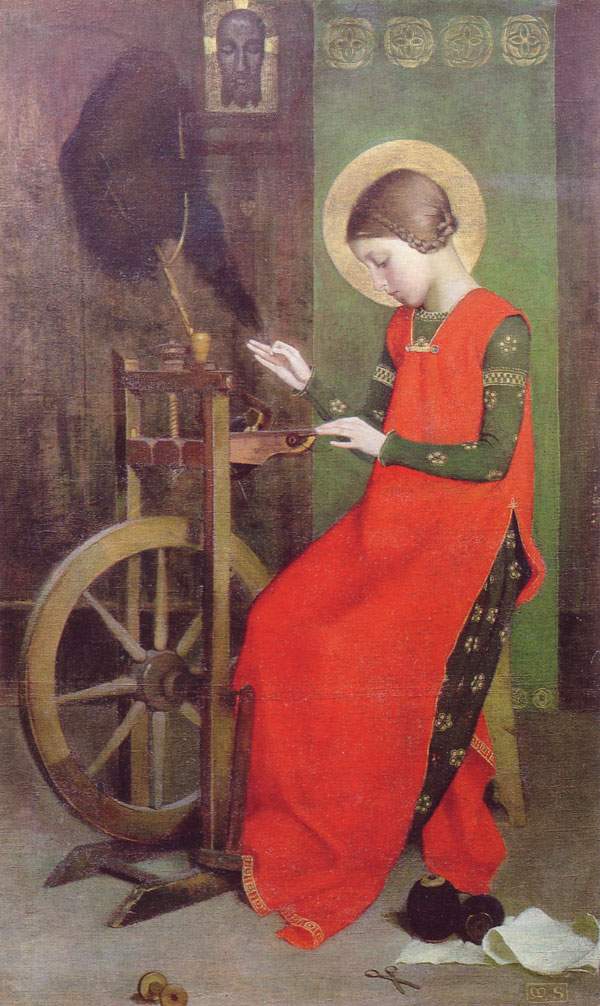
'Thumb' by Marianne Stokes, 1894 
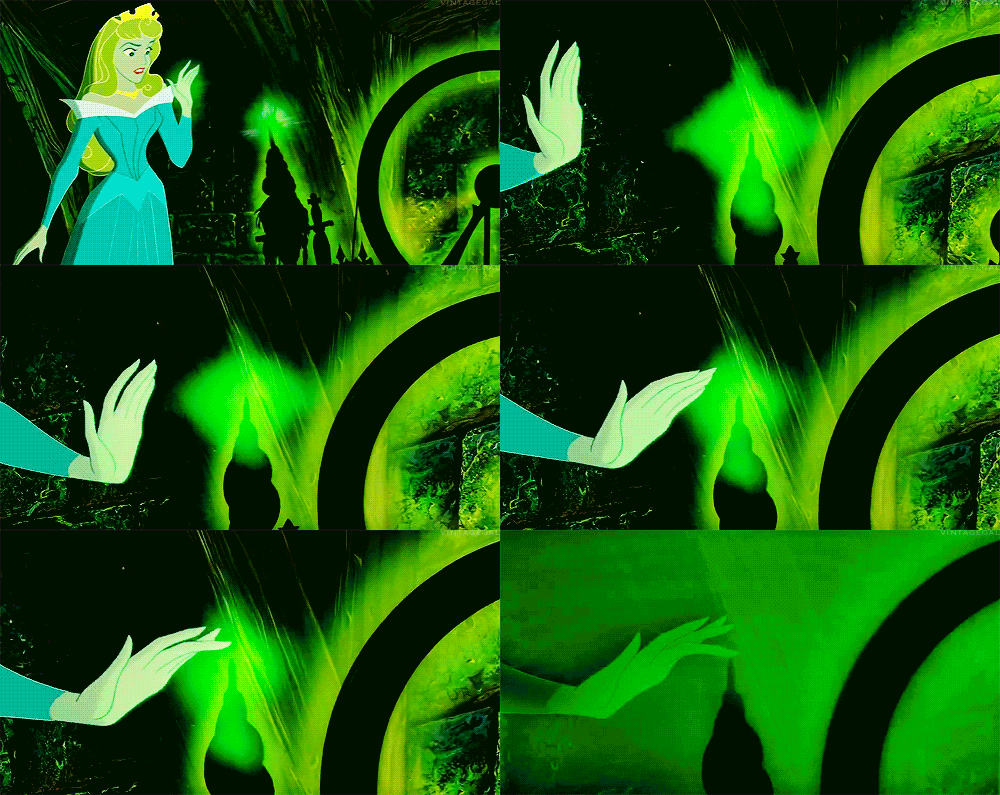
The spinning wheel or the spindle make appearances in more than a few tales. Most famously the Sleeping Beauty is cursed by the Sleeping Death when she pricks her finger. In the tale of Rumpelstiltskin a spinning wheel is given to a poor Millers daughter after her father lies to the King, announcing that his daughter can spin straw into gold. Trapped within a cell the girl is told that if she can spin a heap of straw into gold she will be liberated. The girl is saved when she bargains with a malevolent imp that magically appears to her in the cell, bargaining for her first born child. In similar fashion three deformed women appear to a young girl when she is faced with a similar task in Grimm's tale The Three Spinners, the girl is saved when she makes a promise to invite the women to her royal wedding, socially transforming them into figures of nobility. 

In the tale of Sleeping Beauty an infant princess is cursed at her Christening party. This plight occurs when one wise woman/fairy is not invited to the celebration. There are thirteen fairies and they can only eat from golden plates. When the King and Queen discover that there are only twelve plates, they decide that one woman must not be invited.

'A Book of Fairy Tales' Janet and Anne Grahame Johnstone, 1977 

'And when the eleventh of them had their say, in came the uninvited thirteenth, burning herself to revenge herself, and without greeting or respect, she cried with a loud voice, "In the fifteenth year of her age the Princess shall prick herself with a spindle and shall fall down dead." And without speaking one more word she turned away and left the hall. Every one was terrified at her saying, when the twelfth came forward, for she had not yet bestowed her gift, and though she could not do away with the evil prophesy, yet she could soften it, so she said, "The Princess shall not die, but fall into a deep sleep for a hundred years.' ---The Brothers Grimm  

'The Sleeping Beauty', Maxfield Parrish

In one of the earliest variants of this tale (1634) Italian, Giambattista Basile's Sun, Moon and Talia. The Princess' fate is foretold by wise men and astrologers who predict the childs' fate at her birth, and her danger here is with a splinter of flax upon which she uses to spin, as opposed to the spindle itself. This is perhaps a more relatable circumstance, as most traditional spindles did not have a needle upon them. The curious thing about the Grimm version of the tale, is what virtue the Princess was missing as the wise fairy had to change her plans? It is arguably 'wisdom', as paradoxically that would be the very thing that would prevent her from touching a spindle. 

A radical anthropological study published in 1987, by Chris Knight, Doctor of Philosophy, University College London, seeks a more physical truth behind familiar tales. In his thesis titled: Menstruation and the Origins of Culture he explores the metaphorical allegory in our most famous tales. In his essay he describes a pre Christian (Gregorian) calendar in which the moon was recognized in thirteen lunar months, as opposed to twelve. 

Walt Disney's 'Sleeping Beauty', 1959

"The menstrual spell is a cyclical occurrence, just as is seasonal change. Time, in the traditional view, is itself cyclical. The king, in attempting to destroy all spindles, is symbolically attempting to suppress the spinning by women of the threads of time – threads which wind like yarn around a spool. We may also infer that he is hostile to “spinsterhood”. A traditional occupation for unmarried or secluded women may have been spinning, so that a woman who never married became seen as permanently a “spinster”. Be that as it may, when the princess explores the unfamiliar stairway and discovers the old witch spinning flax in her turret in the sky, she is contacting the world of seclusion and discovering for herself the ancient feminine mistress of lunar time. Like the thirteenth fairy, this old woman brings menstrual bleeding as a gift – or, if socially-rejected, as a curse.
The girl “pricks her finger.” She bleeds, as any girl of her age eventually must. The King was foolish to try to banish the spinning-wheels or spindles, for time cannot be suppressed – every girl will come of age and bleed, her cycle itself being among the most ancient of all clocks. And as the princess bleeds, the ancient power of the blood strikes out with a vengeance against all who had believed they could defy it. The whole palace, the whole kingdom is plunged into another realm beyond waking life. All normal domestic activities cease. It is as if time stood still. Those who believed that they could alter the ancient calendar, they could abolish the thirteenth month, they could suppress the hallowed logic of menstrual time are now put firmly in their place. They will be excluded from time’s flow for a hundred years.
As the princess sleeps on, it is as if her blood had erected around her an impenetrable barrier to her ever getting married. Would-be suitors are kept at bay by a deadly hedge of thorns. She herself is now in menstrual seclusion of a particularly rigorous, long-lasting kind, with the whole palace in seclusion with her.
But every period of seclusion – even a hundred-year one – must eventually expire. And when the time has come, lovers are free once more to approach. The spell breaks, the thorns turn into flowers. The hedge parts, allowing the young hero to enter and deliver his kiss. The sex-strike and the cooking-strike are over; the palace servants resume their domestic chores. Marital relations are resumed, and are celebrated in the palace with a royal wedding and feast." (Chris Knight, Doctor of Philosophy, University College London, 1987) You can read the full essay here.

Chris Knight's essay goes on further with other tales, in the case of Jack and the Beanstalk, Jack's exploration up the erect vine and to a giantess is metaphorically allegorical of his sexual awakening. The most curious thoughts we are led to in the tales of the spindle and the spinning wheel weave around issues of time, the spinning of the wheel itself is represented by time in passing. In the case of the Miller's daughter and Rumpelstiltskin, it took many years for the Princess to escape her promise to the wicked imp. In Sleeping Beauty, she lay in the state of sleeping death for one hundred years.

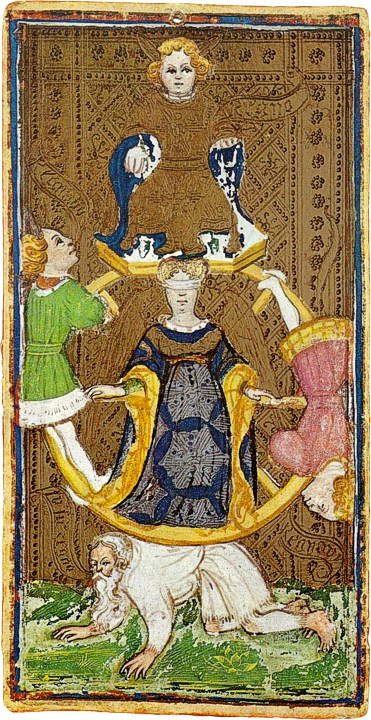
Fortuna, as seen in European Iconography

In the ancient medieval practice of Tarot reading, The Wheel of Fortune expresses the positive and negative dynamics of fate, and paradoxically it exists alongside minor arcana that bare the names King and Queen.    

Visconti Tarot, 1450


Source Materials:
  • Grimm's Complete Fairy Tales, Barnes and Noble Inc. 1993
  • An Encyclopedia of Fairies, Katherine Briggs, Pantheon Books, New York, 1976
  • The Sleeping Beauty: Illustrated by Arthur Rackham, Exter Books, 1972
  • English Fairy Tales, Joseph Jacobs, first published in 1890, Every Man's: Library Children's Classics
  • Mastering the Tarot, by Eden Gray, Signet Books 1971
  • radicalanthropologygroup.org
  • dictionary.com
  • wikipedia.com