Thursday, March 17, 2016

The Old Ways

There is a calling to some when St. Patrick's Day rolls around. We are entertained by evolved images of fairies and tricky leprechauns. While the little people dance now within all too cartoonish realms such as cereal boxes and Disney cartoons, they were once a practice of belief and a way of life. To the ancient Celts, faeries or "The Good Neighbors" as the called them, existed as nature spirits dwelling within the sea as well as the forest. The earliest accounts of fairies describe figures who weren't always tiny but able to take many dynamic forms. The idea that a fairy is a tiny benevolent creature is fairly modern, the advent of it's wings being it's most recently described detail.

Jean-Baptiste Monge
 Long ago fairies traveled through revels in the sky upon items borrowed from humans such as broomsticks. There were accounts of fairy raids, large hunting parties traveling through the clouds, not unlike Odin and his Great Hunt in Norse Mythology. There were also fairy processions, gatherings with pipes, merry making and dancing deep within the forest. Before Christianity they were the figures, both benevolent and malevolent, who existed on a spiritual plane in some ways the undead. After Christianity spread throughout the world they became the angels and demons bared from both heaven and hell, damned to remain in a state of purgatory until the final judgement. History shows that in more recent encounters wicked fairies could be warded off with the likes of holy water and the image of the cross (,not unlike vampires).
The rise of the Tuatha De Danann (pre-Christian Celtic gods) channeled ancient ideas and stories into spiritual-like men. This mythological evolution led to our modern tales of Camelot. The violent rise of Catholic theology forced the old world and it's beliefs out of Ireland perhaps not unlike the snakes driven by St. Patrick himself. The Celtic tradition is a rich history that has been plagued by deracination and war.
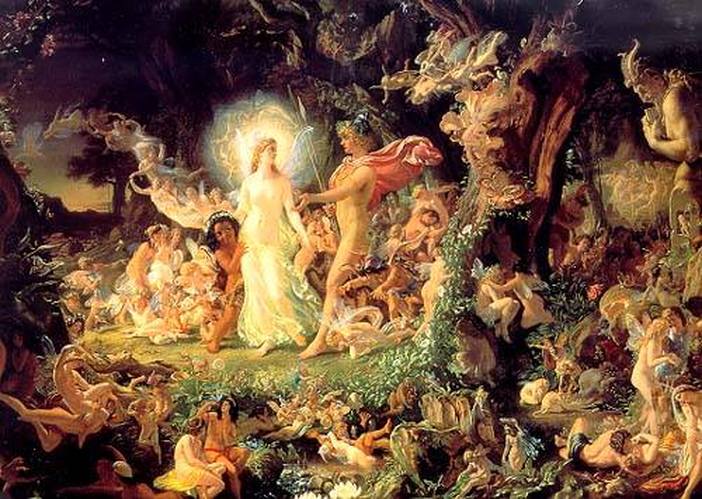
The Quarrel of Oberon and Titania (1849) by Joseph Noel Paton
When delving into the world of faerie it is important to know that not one is alike. The modern miniature figure with filmy wings is a pixie and had nothing to do with the fairies of old. Pixies are prevalent within tales of the Brother's Grimm and works by Joseph Jacobs. J.M. Barrie's Tinkerbell is a prime example of  the beautification and dumbing down of old world creatures. The Victorian Age is mostly responsible for the beautiful way we now see these figures, for the Victorian Age gave us the fairies who granted wishes and became Godmothers. In Celtic myths, especially Irish and Welsh fairies were closer to human beings with supernatural powers, Morgan Le Fay from Arthurian Legend is a primary example. These fairies were often benevolent but at other times frightening and cruel.
It is believed that the leprechauns and fairies of Irish folklore come directly from an Ancient divine race called the Tuatha De Danann. The Tuatha De Danann were the last mythical race to inhabit the Emerald Isle before they were taken over by the Celts/Gaels. Tales of the Tuatha De Danann are multifaceted and their rich history is certainly a subject to be further explored. When tying them to the history of fairies it is important to mention tales about the Sidhe. Much of Ireland history including mythology involves peoples and cultures who were defeated and fled. The Sidhe are fairies who remained by building their rich kingdoms under hills and deep into subterranean territories.
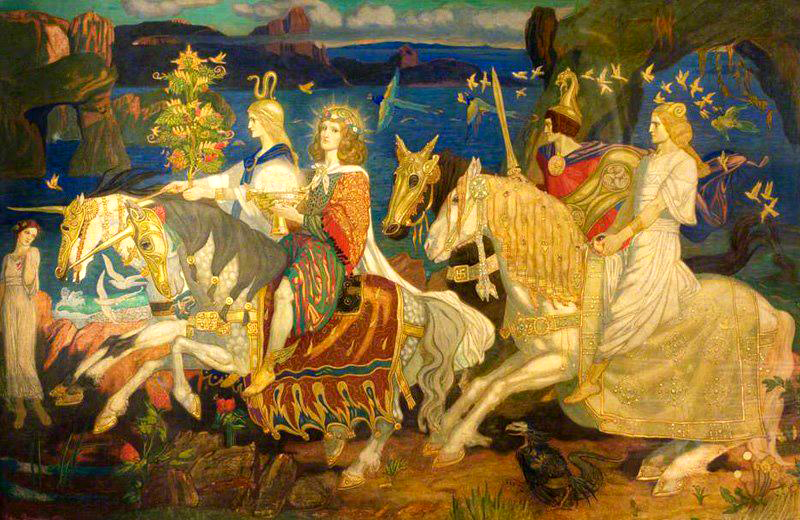
"The Riders of the Sidhe" (1911) by John Duncan
"In some fashion were the Tuatha Dè consigned to live below the earth’s surface, in sidhs, or mounds. They became known as ‘Aes sidh,’ or people of the mound. They dwell in their underground palaces and cities, and sometimes appear above the land, to switch mortal children with fairy children, grant wishes to people, or engage in other shenanigans. The Sidhe, also called the Fairy-Folk or “little people” are still said to populate Ireland today, practicing magic and mischief in their glorious, glittering kingdoms in the fairy mounds dotting the landscape of the Emerald Isle."---*Vincent Byrne
Jean-Baptiste Monge
Sidhe/sidh, Sith, or Si (shee) is Gaelic for Fairies in the Highlands of Scotland, as well as Ireland.

One famous fairy, the Bean Si (shee), Gaelic for 'fairy woman', is commonly known as the banshee. Subsequently she is also known as the Bean-Nighe in the Highlands of Scotland.
Jean-Baptise Monge
The Daoine Sidhe (theena shee) are the dwindled gods of the Tuatha De Danann
Jean-Baptiste Monge
"Other names are however given them for safety's sake, 'the Gentry', the 'Good People'. the 'Wee Folks', 'the People of That Town', or other euphemistic names. A good account of these Irish fairies is given by Yeats in the first few pages of his Irish Fairy and Folk Tales. 'They are the typical Heroic Fairies, enjoying the pleasures and occupations of medieval chivalry. Even in modern times their small size is not invariable; they are occasionally of human or more than human stature. Their habitations are generally underground or underwater, in the green raths or under the loughs or in the sea. These underwater fairies are described by Lady Wilde in Ancient Legends of Ireland (Vol. I, p. 68). They are supposed to be those of the Fallen Angels, too good for Hell: 'Some fell to earth, and dwelt there, long before man was created, as the first gods of the earth. Others fell into the sea."---*Katherine Briggs
Jean-Baptiste Monge
In Irish Fairy and Folk Tales W. B. Yeats famously divides fairies into two classes, Solitary Fairies and Trooping Fairies. To this day these are considered good distinctions between peoples who still hold fairy beliefs. Trooping fairies are known to sport the color green as opposed to the solitary fairies who wear red. These fairies are commonly found, throughout many regions, within the forest. They appear in various shape and size, the tall fairies are those known to preform heroic acts and good deeds. The small have various capabilities, most notably mischievous dancing and merry making within fairy rings. It is known that they possess the supernatural power to abandon time, this is perhaps one of the most dangerous positions for a mortal. An ancient medieval superstition was a warning to steer clear of toadstool rings. Yeats describes the smallest of the creatures with caps the size of heather bells. The most famous of the trooping fairies in Irish legend are the ones who dance and sing inside the fairy hills, these are the mischievous creatures responsible for Changelings and Fairy Brides. Tales of changelings and fairy brides provide disturbing circumstances where a human has been replaced by the likes of a fairy. Many of these legends survived on into the witch craze and were used to condemn people to death, all one had to do was provoke the idea of a changeling. The changelings are not unlike the famed Irish Selkies, who's subject can be largely explored in another post.
Jean-Baptiste Monge
Solitary fairies are as they are called often solitary creatures. They are rugged in appearance, some banished from they fairy court for dealings with human beings. A most serious offense was the act of making love to a human. These creatures are ominous and represented by the banshee, brownies and shape shifting witches. Brownie's are the most known solitary fairies. They often dwell in the country and make efforts to finish work that may be left undone to a farm or farmhouse where they live. At times they may become attached to one member of a family.
Jean-Baptiste Monge
"He is allowed his little treats, however, and the chief of these are knuckled cakes made of meal warm from the mill, toasted over the embers and spread with honey. The housewife will prepare these, and lay them carefully where he may find them by chance. When a tidbit is given to a child, parents will say to him, 'There's a piece wad please a Brownie."---William Henderson, Folklore of the Northern Counties (p. 248) 
Jean-Baptiste Monge
It is important to note that offerings were made to these creatures where they might discover them on their own. It was taboo to upset a Brownie, as they were not human. They could very easily abandon a post where their effort was needed even become a more malicious hobgoblin, who were interested in practical jokes, they could become nasty if provoked. This is where the modern bogeyman comes from.

There are three solitary figures who have been wrapped into one. The Leprechaun was known as the shoemaker, the Cluricaune who haunts wine and beer cellars, drinking and smoking. Then there is the Fir Darrig who is the mischievous practical joker. Yeats suggested that the three were all aspects of the same figure. All leprechaun stories share a similar experience of a human being thwarted after the belief that he would come upon some great treasure.

Lady Wilde can be credited for our modern depiction of this pseudo brownie. She states in her Ancient Legends of Ireland in 'The Leprechaun' (vol. I, p. 103): "The little fellow dressed all in green , instead of wearing a red cap, a leather apron, drab clothes and buckled shoes, and the boy, who has fairy blood in him, succeeds in winning a wealth of treasure from an underground cave, keeps his gain secret and is the founder of a prosperous family."
Jean-Baptiste Monge
The Cluricaune may be one of the most comedic of all fairies. He is a drunkard found in cellars, ready to scare a dishonest servant who steals wine. Often a Cluricaune would be the cause for a owner to relocate, at which point the fairy would hide in a cask so as to move with him. Thomas Crofton Croker describes them in his 1823 book titled: Fairy Legends and Traditions of the South Ireland: "He wore a red nightcap, a leather apron, pale-blue long stockings and silver buckled, high-heeled shoes. Presumably his coat was red, for solitary fairies were generally supposed to be distinguished from Trooping Fairies by wearing red instead of green coats."
Jean-Baptiste Monge
The Fir Darrig dresses very similar to the Cluricaune. Yeats describes the Fir Darrig in Irish Fairy and Folk Tales: "The Far Darrig (fear dearig), which means Red Man, for he wears a red cap and coat, busies himself with practical joking, especially with gruesome joking. This he does, and nothing else." To contradict these actions it is the Fir Darrig who is also known to give advice to a human captive in the fairy realm.  

Leaving cookies out for Santa comes from a long tradition of gaining good favor with the little people, although with the likes of the Cluricaune it was probably more suitable to leave a thimble of beer and a pinch of fresh tobacco.
Jean-Baptiste Monge
There are many rich tales throughout many regions, even outside of Ireland who suggest that fairy belief was more than folktales and fiction, it was a way of life. The fairies came with blessings and caution, representing duality and earth based spirituality. Modern holiday practices would have no essence without the old way and superstition. Many anthropologists suggest that these belief's and ways of life have left. The faeries have therefore traveled back to the sea and the sky through revels of hooves and wings.  In some regions of the Scottish Highland fairy faith remains strong to this very day.

Loreena McKennitt, Celtic enthusiast and New Age artist in her 1991 Album titled: The Visit, explores the fleeting world of Ireland that once was in the song titled: The Old Ways, the world of the Tuatha De Danann, the world of the fairies.

You can listen to it here: The Old Ways
Jean-Baptiste Monge
Source Material:

*This blog post would not be possible without Katherine Briggs. Katherine was born 1898 and died in 1980. She studied at Oxford and was President of the English Folklore Society. Her contributions to the study of historical folklore and literature are unprecedented.

*All un-credited pictures by Jean-Baptiste Monge

*There are a few hidden links in scattered words throughout this post.
  • The Vanishing People: Fairy Lore and Legends, Katherine Briggs, Pantheon Books, New York, 1978
  • An Encyclopedia of Fairies: Hobgoblins, Brownies, Bogies, and other Supernatural Creatures, Katherine Briggs, Pantheon Books, New York, 1976
  • Notes on the Folk-Lore of the Northern Counties, 2nd edition, F.L.S. London, 1879
  • Ancient Legends, Mystic Charms and Superstitions of Ireland, Lady Wilde, 2 vols.,London, 1887
  • Fairy Legends and Traditions of the South of Ireland, T. Crofton Croker, 3 vols., London, 1825-8
  • Lorenna McKennitt: The Visit: The Old Ways
  • www.celtic-weddingrings.com/celtic-mythology
  • www.timelessmyths.com
  • Wikipedia.com
  • Dictionary.com
  • Soundcloud.com
Friday, December 18, 2015

Do you Believe in Santa Claus?

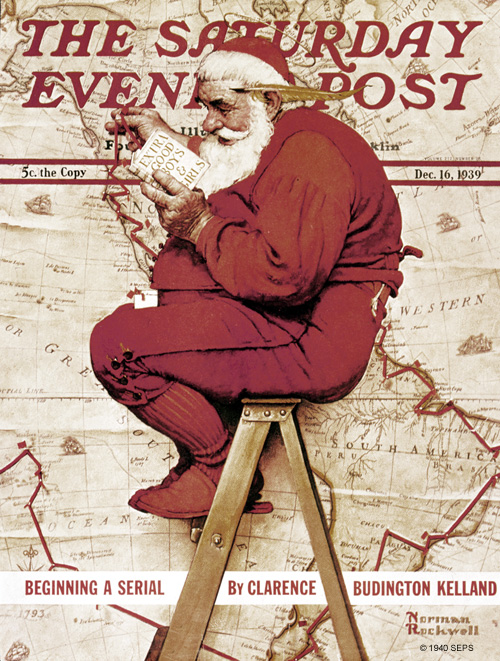
Norman Rockwell, 1939
When the first December frost arrives we look to the holidays in anticipation of celebration, the season of hope and enchantment, perhaps the very time of year when we first learned about magic. For on Christmas Day, as children we knew anything was possible. Our wishes and hopes would be rewarded when we discovered gifts under the Christmas tree, at some point we knew not to ask from whom the gifts were bequeathed. Then as we grew and developed, our minds introduced us to an age of skepticism. At a certain point we are challenged with one simple question: "Do you believe in Santa Claus?"
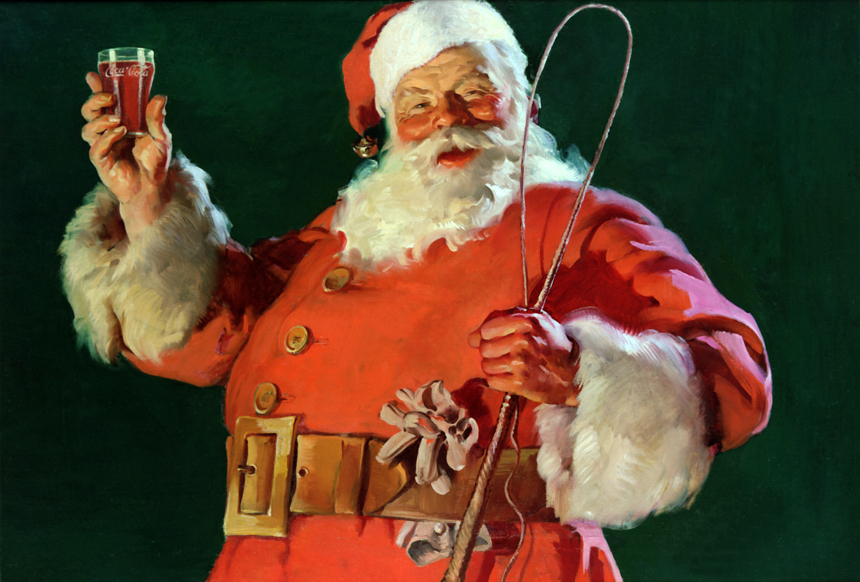
Coca-Cola Santa Claus
There is an ignorant claim that the Santa Claus we know today has been perpetuated by the Coca-Cola Company as a ploy to boost profit and sales. This is far from true, Santa Claus has a rich history, he is the culmination of winter tradition that transcends more cultures than can be counted. He has many names: St. Nicholas, Father Christmas, La Befana, Christkindl (Kris Kringle), Kolyada, Sinterklaas, Père Noël, etc.

St. Nicholas, Arthur Rackham 1907
Anthropologically Christmas is a celebration of light, the festival in which on the Winter Solstice ancients would feast and honor the mid-point of harsh winter. Yuletide fires honored the sun whose warmth would return in the spring. Bonfires evolved and became candle wicks lit within trees, a continued tradition to honor the light of the fire that provides warmth from the bitter cold and a symbol for the sun who retreats in the winter. When ancient primitive tribes gathered in circles to honor the solstice they had many Shamanistic rituals. One was to dress in their finest furs with masks and travel from lodging to lodging demanding victuals. Within these circles one Elder who was considered the Patriarch was honored because it was believed that he alone harnessed the power to bring back the light. 

'English masked balls of the 17th Century dubbed him Noël, and he is the forerunner of St. Nicholas (Santa Claus) and Father Christmas.' ---Edouard Brasey, Faeries & Demons

Anne Stokes
Many of our modern depictions of Santa Claus have developed from Norse mythology. Norse legends weave around a central god figure called Odin. Like Zeus, Odin roamed the world taking part in many activities. The night of the Winter Solstice was set aside as the great hunt for Asgard, a time when the air is filled with the sounds of galloping hooves as Odin and his knights soar through the sky. Odin is followed by a great league of elves and spirits. Mortals upon the earth who offered him reverence were bestowed with gifts.

George Von Rosen 1886
"So we abandoned the former God Odin and his company, but everything that was once attributed to him and everything that used to be done in his honor such as, among other things, leaving the last ear of corn for his horse, now shifted partly to Saint Nicolas; we mounted the bishop on a horse, gave him a black valet with a whip and a bag of cinders and called them Saint Nicolas the Demon." --- Rond den Herd, Guido Guezelle

'The Wild Hunt', Peter Nicloai 1872
Odin's flight, gifts, elves and even his war horse were handed to Saint Nicholas.

St. Nicholas Center, Holland
There are many legends both light hearted and dark in which St. Nicholas helps men and children alike by performing various miracles. Because he could calm storms he is known as the patron Saint of Sailors and because he restored to life three murdered boys he is the patron Saint of Children. 


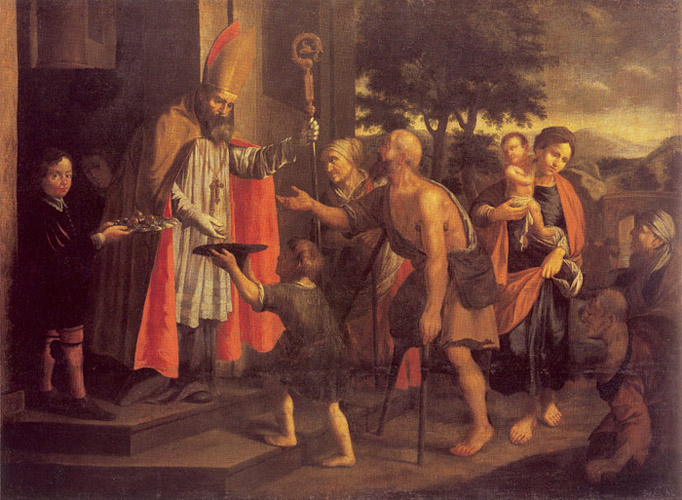
St. Nicholas of Christian legend was a priest from a wealthy family in Patara near Myra (Asia-Minor) in what is now modern day Turkey. Born around 280 AD he was known as a kind man who traveled the country gifting his wealth to the less fortunate. Some legends regard him as a powerful man who had a talent for miracles. St. Nicholas was extremely devoted to the less fortunate and especially children. He had a peculiar way of hiding gold coins in peoples shoes because he was modest and never wanted to be thanked. One of his greatest legends begins a such: A poor man had three daughters whom he could not marry off, the reason being that each had very little to no dowry. In these times when a female child reached a certain age and could not be married off they were sold into prostitution. Legend has it that when Nicholas learned about the girls plight, he decided to take action. When the first and second daughters came to age he tossed each a bag of gold through an open window while they were resting in the night. For the third daughter he discovered the poor man searching for his benefactor and in an effort to remain anonymous tossed the third bag of gold down the chimney. (It is in the memory of this generous moment that children gather before the chimney.) Each daughter then had a dowry and could be married happily.

St. Nicholas Giving Alms, Jan Heinsch
'During a famine in 311-312 CE, a ship full of wheat docked in the port of Myra, headed for the Emperor in Constantinople. St. Nicholas, the Bishop of Myra, asked if the sailors wouldn't mind giving him some wheat for the poor, but the sailors refused, because the Emperor had been promised a certain weight of wheat so they couldn't give any away. Nicholas told them whatever they gave him, the sailors would suffer no losses. And indeed, when they arrived in Constantinople, the weight was somehow the same.' ---gizmodo.com 
Vintage Father Christmas Card
 Though now Father Christmas is synonymous with Santa Claus he is actually a much older folkloric figure, a personification of Christmas itself. In 15th Century England a personified 'Christmas' figure, taken from ancient celebrations, traditionally an old man at adult parties, would announce the birth of Christ and encourage every one to drink and be merry. (These circumstances are expressed in an ancient carol written by Richard Smart, Rector of Plymtree from 1435 to 1477.)

Vintage Father Christmas Card
16th Century Elizabethan era defined Father Christmas with green and sometimes scarlet robes lined with fur.
Vintage Father Christmas Card
"The specific depiction of Christmas as a merry old man seems to have emerged in the early 17th century. The rise of puritanism had led to increasing condemnation of the traditions handed down from pre-Reformation times, especially communal feasting and drinking. As debate intensified, those writing in support of the traditional celebrations often personified Christmas as a venerable, kindly old gentleman, given to good cheer but not excess. They referred to this personification as "Christmas", "Old Christmas" or "Father Christmas". At the time "Father" was a title sometimes given to older men worthy of respect: "---wikipedia 
Kansas City Repertory Theatre
In the 18th Century Father Christmas, a common figure at holiday parties was utilized as a particular brand to inspire generosity, differing from our modern Santa he spends his holiday time feasting and drinking. A proper depiction of this development is found in the 'Ghost of Christmas Present' in Charles Dickens immortal classic A Christmas Carol (1843). The Ghost of Christmas Present is a boisterous giant who wears a green robe lined with fur. He embodies the spirit of Christmas and carries a torch which is reminiscent of the bright fires in ancient solstice ritual, he can anthropologically be compared to the ancient Shamanistic Elders who were believed to have the power of light. 
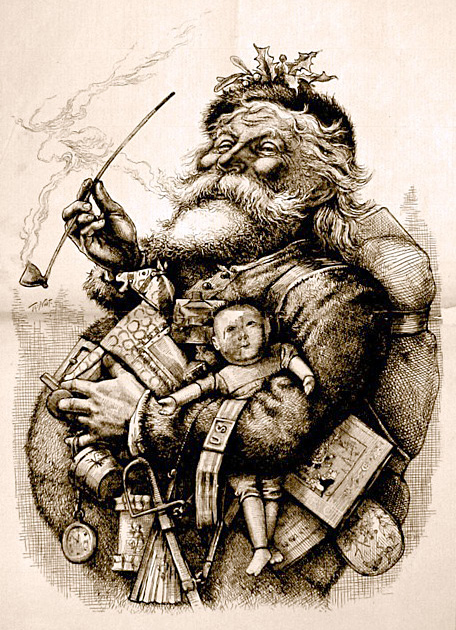
'A Visit from St. Nicholas', Thomas Nast 1881
The most notable contribution to Santa Claus as we know him comes from famed author Clement Clark Moore in his poem A Visit from St. Nicholas, first published in the New York Sentinel in 1823. This is the beloved poem that begins: T'was the Night Before Christmas.


   He was dressed all in fur, from his head to his foot,
And his clothes were all tarnished with ashes and soot;
A bundle of toys he had flung on his back,
And he looked like a peddler just opening his pack.

His eyes -- how they twinkled! his dimples how merry!
His cheeks were like roses, his nose like a cherry!
His droll little mouth was drawn up like a bow,
And the beard of his chin was as white as the snow;

The stump of a pipe he held tight in his teeth,
And the smoke it encircled his head like a wreath;
He had a broad face and a little round belly,
That shook, when he laughed like a bowlful of jelly.

He was chubby and plump, a right jolly old elf,
And I laughed when I saw him, in spite of myself;
A wink of his eye and a twist of his head,
Soon gave me to know I had nothing to dread;

He spoke not a word, but went straight to his work,
And filled all the stockings; then turned with a jerk,
And laying his finger aside of his nose,
And giving a nod, up the chimney he rose;

He sprang to his sleigh, to his team gave a whistle,
And away they all flew like the down of a thistle.
But I heard him exclaim, ere he drove out of sight,
"Happy Christmas to all, and to all a good-night."

'A Visit from St. Nicholas', Arthur Rackham 1849
Clement C. Moore gave St. Nicholas a more elvish appeal, defining his white beard and large round belly. His borrowed aspect of multiple reindeer versus a single horse has remained a North American staple. Santa Claus and his eight reindeer have been a part of the Macy's Thanksgiving Day Parade in New York City ever since 1924. Santa's float is the last in the parade. He is considered the grand marshal of Christmas and once his float is seen it is arguably acceptable to begin holiday festivities. 

Natalie Wood & Edmund Gwenn, 1947
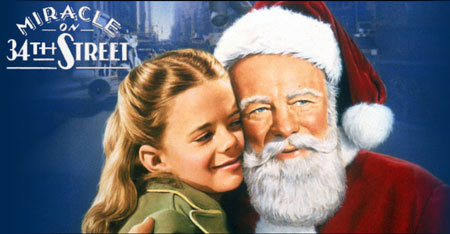
With the development of talking pictures Santa Claus has a history of appearing in cinema. His most notable portrayal is seen in the 1947 film A Miracle on 34th Street. 34th Street is the famous street in which Santa Claus was first welcomed into Herald Square after the very first Macy's Day Parade. In A Miracle on 34th Street Santa Claus saves the Macy's Day Parade when he replaces an intoxicated Santa impersonator. He then goes on to fill his role at the Macy's department store. After a series of events Kris, as he calls himself, is put on trial and a Judge must determine if Santa truly exists. This film is an instant classic, it challenges Christmas perceptions and the power of belief. 

Edmund Gwenn 1947
"You think I'm a fraud, don't you...I'm not just a whimsical figure who wears a charming suit and affects a jolly demeanor. You know I'm a symbol, I'm a symbol of the human ability to suppress the selfish and the hateful tendencies that rule the major part of our lives. If you can't believe, if you can't accept anything on faith then you are doomed for a life dominated on doubt." ---Kris Kringle, A Miracle on 34th Street (1994)

Vintage Santa Claus
The most beautiful examination of Santa Claus was written as a response letter to a little girl in 1897 named Virginia O'Hanlon. Virginia took it upon herself to write to a prominent New York newspaper called The Sun after she had inquired about the existence of Santa Claus with her own father. Her father inspired her by saying: "If it is in the sun, then it is so." The Sun's editor who received the letter, Francis Pharcellus Church was then given the opportunity to philosophically answer the girls question and because he did not dismiss the child it is perhaps the most beloved editorial of all time. 

    
We take pleasure in answering thus prominently the communication below, expressing at the same time our great gratification that its faithful author is numbered among the friends of The Sun:
Dear Editor—
I am 8 years old. Some of my little friends say there is no Santa Claus. Papa says, "If you see it in The Sun, it's so." Please tell me the truth, is there a Santa Claus?
Virginia O'Hanlon
115 West Ninety Fifth Street
Virginia, your little friends are wrong. They have been affected by the skepticism of a skeptical age. They do not believe except what they see. They think that nothing can be which is not comprehensible by their little minds. All minds, Virginia, whether they be men's or children's, are little. In this great universe of ours, man is a mere insect, an ant, in his intellect as compared with the boundless world about him, as measured by the intelligence capable of grasping the whole of truth and knowledge.

Yes, Virginia, there is a Santa Claus. He exists as certainly as love and generosity and devotion exist, and you know that they abound and give to your life its highest beauty and joy. Alas! how dreary would be the world if there were no Santa Claus! It would be as dreary as if there were no Virginias. There would be no childlike faith then, no poetry, no romance to make tolerable this existence.

We should have no enjoyment, except in sense and sight. The external light with which childhood fills the world would be extinguished.

Not believe in Santa Claus! You might as well not believe in fairies. You might get your papa to hire men to watch in all the chimneys on Christmas Eve to catch Santa Claus, but even if you did not see Santa Claus coming down, what would that prove? Nobody sees Santa Claus, but that is no sign that there is no Santa Claus. The most real things in the world are those that neither children nor men can see. Did you ever see fairies dancing on the lawn? Of course not, but that's no proof that they are not there. Nobody can conceive or imagine all the wonders that are unseen and unseeable in the world.

You tear apart the baby's rattle and see what makes the noise inside, but there is a veil covering the unseen world which not the strongest man, nor even the united strength of all the strongest men that ever lived could tear apart. Only faith, poetry, love, romance, can push aside that curtain and view and picture the supernal beauty and glory beyond. Is it all real? Ah, Virginia, in all this world there is nothing else real and abiding.

No Santa Claus! Thank God! He lives and lives forever. A thousand years from now, Virginia, nay 10 times 10,000 years from now, he will continue to make glad the heart of childhood.
-----------------
"Is There a Santa Claus?" reprinted from the September 21, 1897, number of The New York Sun. 

     
Source Material:
  • The Enchanted World Series: The Book of Christmas, Time-Life Books,1986
  • Faeries and Demons and Other Magical Creatures, Edouard Brasey, Barnes and Noble Books New York, 2002
  • St. Nicholas to Santa --- National Geographic.com
  • 11 Insane Things You Didn't Know About Santa Claus --- i09.gizmodo.com
  • The Legend of St. Nicholas --- History.com
  • wikipedia.com
  • dictionary.com

Saturday, October 31, 2015

Origin of the Jack O' Lantern


What would October be without Jack-O-Lanterns? Holiday celebrations are incomplete without pumpkins with twisted expressions and glowing eyes. Traditional carved pumpkins present a head with perfectly triangular cut eyes and a nose, the mouth, a crooked crescent smile typically dances between menacing and oafish. The harvest would be nothing without this icon. A carved pumpkin, in ways, is a symbol that rises above witches on broomsticks and dancing skeletons. The history of the Jack-O-Lantern is long and predates most of the traditions that we celebrate on Halloween/Samhain. The twisted expression on a carved pumpkins face, in legend, is there to ward off spirits who for one night roam the earth with malicious intentions, although the true historical relevance for our modern Jack-O-Lantern rests with the flame inside.

Will-o'-the Wisp, Arthur Hughes
Ghostly apparitions and unusual lights have been documented all over the world as early as the middle ages. One particular phenomena known as Ignis Fatuus (Medieval Latin for: The Foolish Fire), more popularly Will-O-The-Wisp appears as a ball of light, sometimes a dancing flame over water but most traditionally found in bogs and marshes. It recedes if approached, drawing travelers into unknown territory and sometimes towards a dark precipice. The Will-O-The-Wisp is related to faeries and depending on the region is known to be a trickster. When regarded as a death omen and found in graveyards it is known to be called corpse-candle or dead-candle. Most popularly in English folk belief and European Folklore it is called: hobby-lantern (Worcestershire, Hertfordshire, East Anglia, Hampshire, Wiltshire, and west Wales), friar's lantern (Wales), jenny-burnt-tail (Oxfordshire), jack-o'-lantern (Northamptonshire, Oxfordshire).

Alan Lee, Faeries, 1978
Will-O-The-Wisp comes form "wisp", which is an old world bundle of sticks used as a torch. Will refers to he that holds it, "Will-of-the-torch". This idea holds up to Jack-of-the-lantern or jenny-with-the-lantern, each etymological references to figures with lanterns and lights. Paranormal enthusiasts refer them as orbs. In ancient folk-tales told in Wales, England, Ireland and Scotland protagonists named Will or Jack are doomed to hunt through the marshes for the unobtainable orb. The most popular name Jack comes from an old tale in Ireland in which Jack is referred to as Stingy Jack or Drunk Jack. Drunk Jack makes a bargain with the devil by offering his soul in exchange for a bar tab. Thereafter Jack coaxes the devil into climbing a tree and then carves a cross on the bark below. The devil forgives Jack's debt in exchange for his freedom. Because of his malicious behavior Jack is debarred from heaven and after a great amount of time asks for a place in hell. The devil denies him but as an aid offers an ember to light his way through the twilight world where lost souls are condemned. Jack takes the ember and places it within a carved turnip to use as a lantern. Thus Jack-o'-the-lantern.  

Marc Dalessio
Will-O-The-Wisp is seen with various tricksters in folklore such as Puck or Robin Goodfellow and the Phooka. The Púca in Irish lore is known for to help or hinder a figure, sometimes leading them to their demise.
Arthur Rackham, 1905
"Various legends account for Ignus Fatuus. Sometimes it is thought to be a tricksy BOGGART, and where it is called 'Hobbley's lantern', this is plainly so; sometimes ghostly in origin, a soul for some sin could not rest. For instance, a man who had moved his neighbors landmarks would be doomed to haunt the area with a flickering light. In Shropshire, Will the Smith, after being given a second spell of life by St. Peter, spent it in such wickedness that he was debarred both from Heaven and Hell. The most the Devil would do for him was to give him a piece of burning pit coal to warm himself, with which he flickers over boggy ground to allure poor wanders to their death. In other versions of the tale, the smith tricks the Devil into a steel purse, in which he so hammers him that the Devil dare not admit him into Hell, but in this version the smith tricks his way into Heaven. In Lincolnshire fen country, the WILL O' THE WYKES are Bogles, intent on nothing but evil." ---Katherine Briggs, An Encyclopedia of Fairies


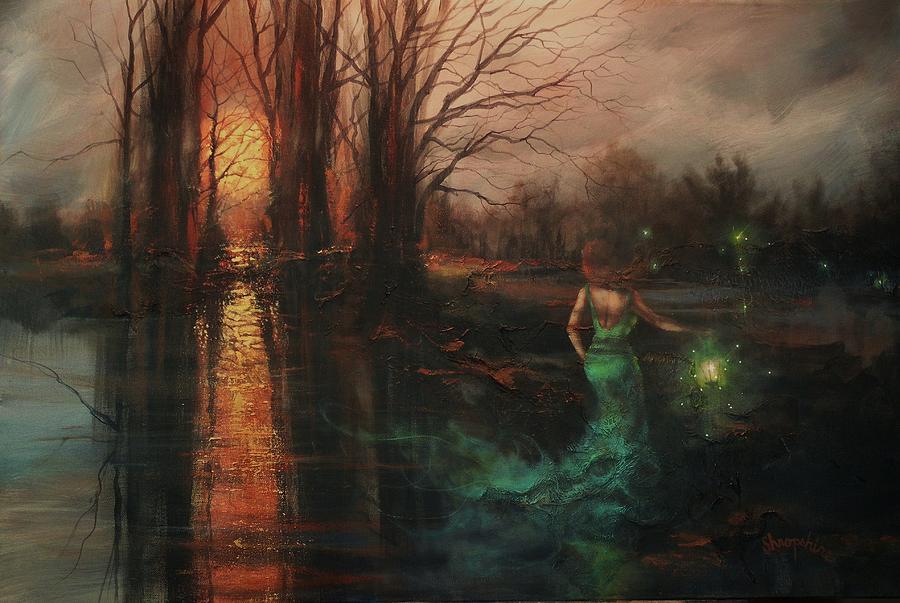
Will O The Wisp, Tom Shropshire
The Will-O-The-Wisp are not unlike Pixies, a type of faerie creature who is known to mislead travelers. They are known for their pranks, often leading humans into the deep and dangerous faerie realm. In old world Europe it was a dangerous thing to be Pixie-led: an expression of leading humans astray. J. M. Barrie the author of Peter Pan must have combined elements of the pixie with the Will-O-The-Wisp when creating Tinker Bell for her most definitive attribute is her light.

There was in every hollow
A hundred wry mouthed wisps.
---Dafydd ap Gwilym (trans. Wirt Sikes) 1340

Brian Froud, Pinterest
The Will-O-The-Wisp is not unknown to science, Sir Isaac Newton mentions them in his 1704 opus Opticks. Researchers have developed mundane explanations for their existence basing the occurrence on marsh gasses, methane, formed from rotting vegetation and ignited by phosphene. The gas in these circumstances is thought to ignite spontaneously establishing a floating flame. The sightings have often been associated to ball lightning. Though science may try to explain faeries, the truth is that the Will-O-The-Wisp is quite unobtainable. The phenomena of the Will-O-The-Wisp has all but diminished and in the last 100 years sightings have become less frequent. Perhaps the over-developed world has swept away bogs and marshes, the very landscapes in which they are found or perhaps they tradition and superstition evolved for there continue to be documented cases for mysterious lights in the sky. 


Source Material:

  • An Encyclopedia of Fairies: Hobgoblins, Brownies, Bogies, and Other Supernatural Creatures, Katherine Briggs, Pantheon Books, New York 1976
  • More English Fairy Tales, Collected by Joseph Jacobs, Dover Publications, New York 1967
  • mysteriousbritain.co.uk
  • inamidst.com
  • wikipedia.com
  • pitt.edu
  • merriam-webster.com


Saturday, October 17, 2015

The Scarecrow

Tim Burton's Sleepy Hollow, Paramount Pictures 1999
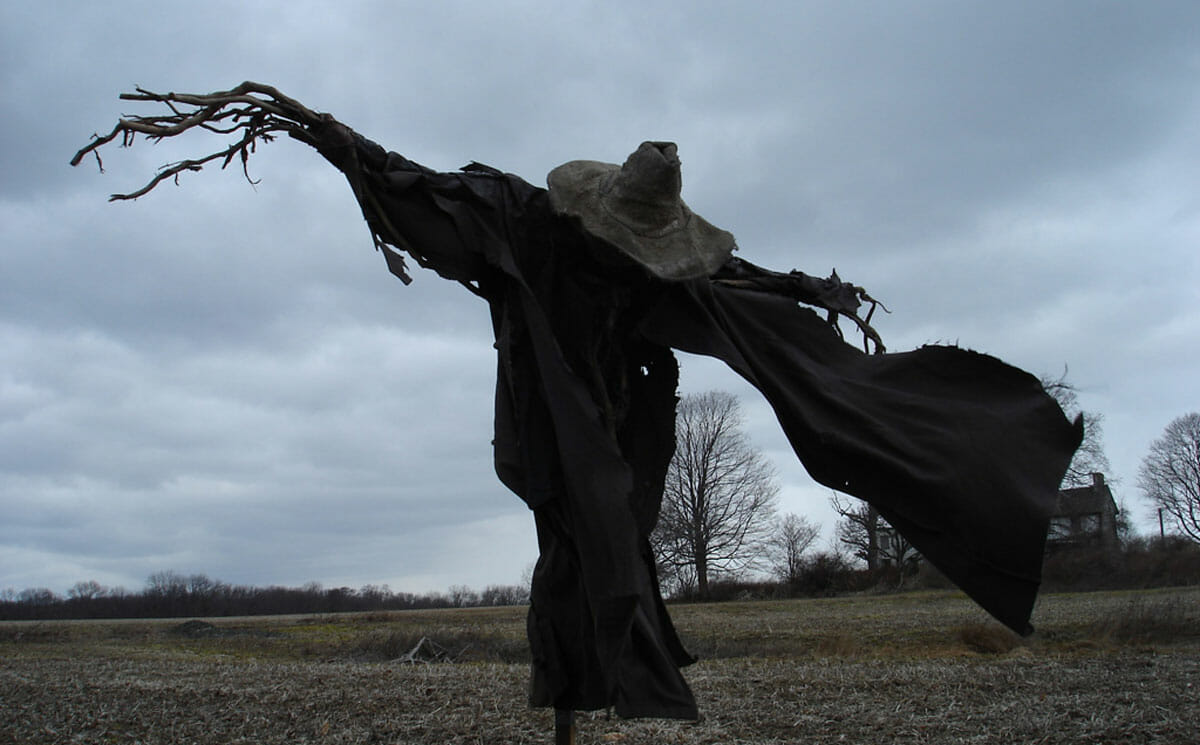
The Scarecrow is a global figure tied to nearly every culture, it stands out historically as an image synonymous with agriculture and harvest. There has never been a comprehensive study on the history of these figures, although the mere image can be viewed and examined anthropologically as their presence has been known to society for quite sometime. Some of the earliest Scarecrows are known to have been placed along the Nile River by ancient Egyptians most distinctively to ward off flocks of quail, who were considered a major pest to crop fields. Ancient Greece had a festival for Priapus, the son of the god Dionysus and and goddess Aphrodite. Priapus was honored as the guardian of vegetation, gardens and livestock, a symbol for health and fertility mostly honored in gardens and homes. Wooden figures of Priapus were built and placed among crops as guardians of agriculture. He was painted purple with a club in one hand to scare the birds and a sickle in the other as a symbol for hopeful harvest.

18th Century Icelandic Manuscript
Ancient images of the Norse god Odin with his two ravens Huginn and Muninn are thought to be early inspirations for the Scarecrow. In Germany Scarecrows were crafted into witches whose flailing arms cast curses against those who dared to invade their territory. Early German immigrants who settled in Pennsylvania in the 1800's were among the first to tie red handkerchiefs to their mannequins in an effort to humanize them, they called them "Bootzamon" whose english translation is Bogeyman. Bogey stems from Bogie which in ancient folklore is name given to one of the most mischievous and frightening creatures, whose sole delight is in the torment of mankind, this figure is attached to the Unseelie Court (a grouping of malevolent creatures/ faeries in Celtic lore. This is perhaps the birth of the popular dark figure of the bogeyman.)

Pumpkinrot.com
Before stick men, children were labored in Medieval Europe to scare birds away from crops by clapping together large wooden sticks. After the Great Plague adults took the job, guarding their crops by hiding in straw-huts in a much similar fashion to the Native Americans. Much later when farms grew considerably larger this was the advent of the earliest effigies, who could stand guard a field without using man-power.

Arnaud de Vallois 2010
Known as perhaps the very first field 'gods' or guards is the Japanese "kakashi", representations of the Japanese deity Kuebiko (the Shinto kami/ god of knowledge and agriculture,) who is unable to walk yet holds all the wisdom of the world. The kakashi, very similar to ancient Greece's wooden Priapus, were crafted with old rags, bells and sticks. They would subsequently be mounted on poles then set on fire, the flames and the smell would keep birds and small animals away. The word kakashi literally translates to "something stinky". Some schools of thought believe that Japanese farmers would utilize the kakashi by attaching spoiled meats and vegetables, and this anthropologically might be the birth of the the image of a scarecrow with a pumpkin-head. There are many names for the scarecrow around the world: To the Scottish he is Tattie Bogle, in Sommerset, England he is known as Mommet. In Berkshire, Isle of Wight he called Hodmedod which translates to "with hat and stick". In Bengali it is kaktadua, pugalo to Russia and straska to the Czech's.

Etching by Jim Yarbrough
Some occult thought tie the scarecrow to deeper historic symbolism. The scarecrow's soul purpose is to frighten and it is nearly impossible to look upon the figure without noticing the cross. The cross is synonymous with Jesus Christ and was used by the likes of Vlad the Impaler who had a propensity for impaling and displaying his enemies to ward off others. Subsequently the scarecrow is also seen as a warning and a symbol for "no trespassing".

D.C. Comics 
Straw-men and Scarecrows are seen throughout classic and modern mythology.  The Scarecrow also known as Jonathan Crane in D.C. Comics is one of Batman's most powerful and popular enemies.

Turnip-Head is a cursed Scarecrow who appears in both the film and the novel titled: Howl's Moving Castle, in the novel he is just known as the Scarecrow. He is definitely an homage to kakashi. He is fashioned upon two cross-bound poles and has a withering turnip for a head. In the film Turnip-Head is revealed to be a prince who suffered an enchantment but is restored by the main character Sophie when his heart is placed back within his chest. This is not unlike the most famous Scarecrow from Oz.  
Howl's Moving Castle, Distributed by Walt Disney Pictures 2004
It would be impossible to contemplate scarecrows and not draw your thoughts to Ray Bolger in the 1939 Classic film The Wizard of Oz. This depiction of the Scarecrow balances out the darker history that the figure once represented. The Scarecrow, along with the Tin Man and the Cowardly Lion are benevolent staples among the pages of fairy tales and children's minds.
Ray Bolger as the Scarecrow in The Wizard of Oz, MGM Pictures 1939
The irony behind the Scarecrow in the Wizard of Oz rests with it's creator L. Frank Baum, who once stated that he had reoccurring nightmares as a child, in which he was being chased by a scarecrow. The development of the figure in his story was established to help him rearrange his fear and he unintentionally did this same for the rest of the world.
John R. Neill 1929
L. Frank Baum wrote into his second Oz novel titled: The Marvelous Land of Oz a character named Jack Pumpkinhead. Jack Pumpkinhead is a play on early European scarecrows who were known as Jack-of-straw. Jack is closer to a traditional scarecrow as he is crafted with wooden sticks and a large Jack-O-Lantern for a head. He was designed by a boy named Tip as a prank on the old witch Mombie. Jack Pumpkinhead becomes quite close to the Scarecrow and eventually a highly regarded citizen in the land of Oz.
Jack Pumpkinhead as seen in Disney's Return to Oz 1985
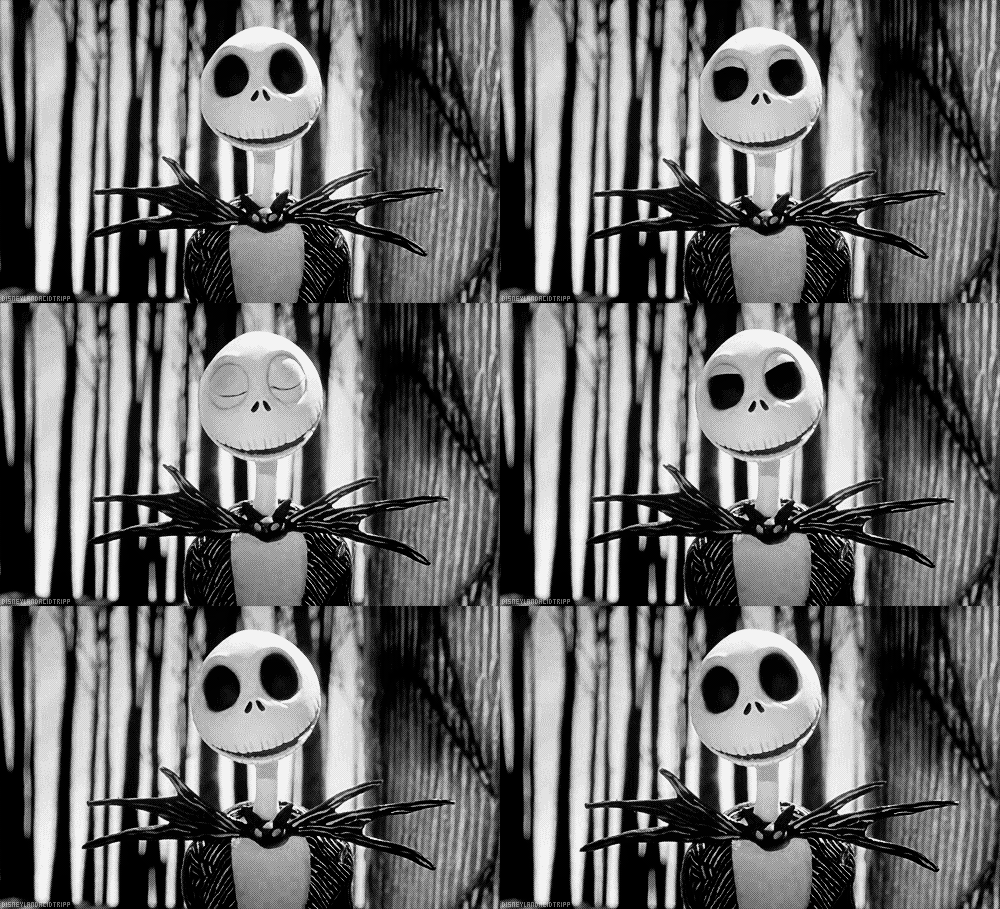
Jack Pumpkinhead is surely the inspiration for Tim Burton's Jack in the 1993 film: The Nightmare Before Christmas. 
Tim Burton's The Nightmare Before Christmas, Touchstone Pictures 1993
Burton's Jack is the Pumpkin King and the leader of Halloween Town. Jack, in a way, represents the strong evolution of the scarecrow and and his perpetual ties to autumn and Halloween.

Tim Burton's The Nightmare Before Christmas, Touchstone Pictures 1993 

Source Material:

  • An Encyclopedia of Fairies, Katherine Briggs, Pantheon Books, New York, N. Y. 1976
  • The Annotated Wizard of Oz, L. Frank Baum, Michael Patrick Hearn, W. W. Norton & Co Inc, 2000
  • The Marvelous Land of Oz, L. Frank Baum, Dover Publications Inc. New York, N.Y. 1969
  • wikipedia.com
  • dicitonary.reference.com
  • howlscastle.wikia.com
  • paganwiccan.about.com
  • pumpkinrot.com
  • scarecrowland.co.uk/history
  • modernfarmer.com